

The kitchen countertop is the hardest-working surface in any home: chopping, slicing, hot pots, water exposure, and hot cooking oils day in and day out. Minor fabrication oversights reveal themselves quickly: stress cracks radiating from sharp cooktop cutout corners, water seeping beneath sink rims into cabinetry carcasses, dark gaping L-joint seams, or mitered drop edges delaminating from poor adhesive bonding.
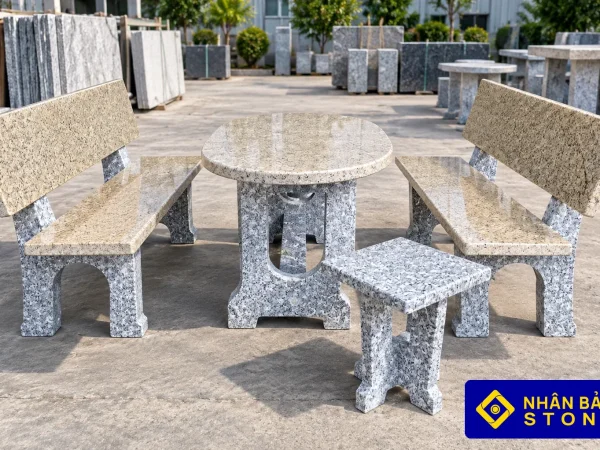
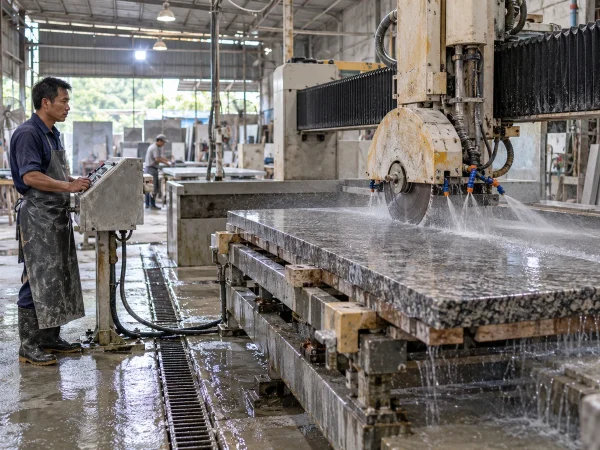
At the NHAN BAN STONE workshop in District 12, Ho Chi Minh City, we fabricate custom kitchen countertops, prep islands, and bar tops tailored to exact cabinet carcass dimensions. Raw slabs are selected at our stone slab warehouse, sawn and cut on precision CNC machinery per approved drawings, edge-finished, and safely crated at our facility. This technical guide outlines the essential engineering choices homeowners, architects, and cabinetmakers should establish before sawing begins.
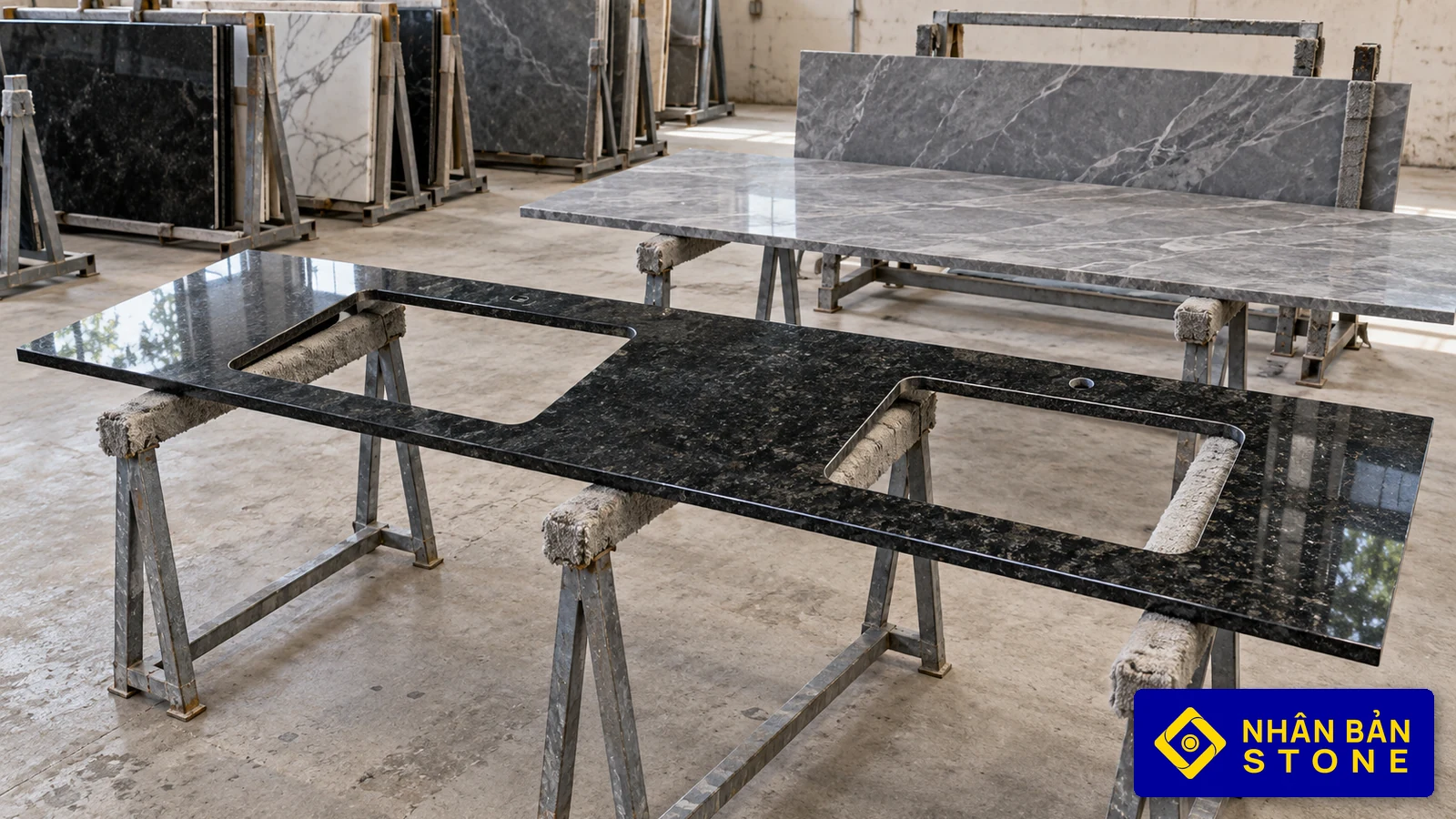
1. Selecting Kitchen Stone: Prioritize How Your Family Cooks
There is no single “best” stone for every kitchen. The real question is: how intensely does your family cook, do you regularly slide hot cookware across counters, do you desire light flowing marble veining, or do you prioritize less daily maintenance?
| Stone Category | Strengths in the Kitchen | Practical Considerations |
|---|---|---|
| Sintered Stone | Ultra-low porosity, scratch-resistant, heat-tolerant, effortless oil cleanup | Edge profiling and cutouts demand careful fabrication matched to the material; trivets still recommended against thermal shock |
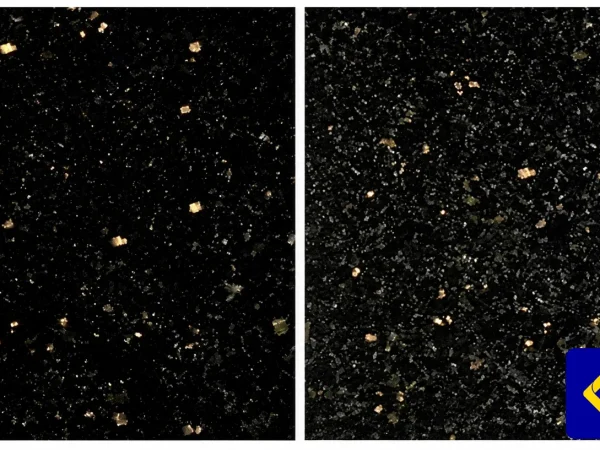
| Natural Granite | Exceptionally dense, impact-resistant, cost-effective for heavy daily cooking | Benefit from initial penetrating sealer; granular crystalline texture rather than fluid cloud veins |
| Engineered Quartz | Uniform colors, pristine white veining, ideal for modern interiors | Do not place hot pots or pans directly on surface; trivets mandatory |
| Natural Marble | Luxurious, incomparable organic elegance | Highly sensitive to food acids (citrus, vinegar), prone to etching; best reserved for backsplashes or decorative islands |
Workshop Insight: If you love natural marble but cook intensely with Asian seasonings and acidic sauces, install marble along the vertical backsplash or decorative island face, while utilizing granite or sintered stone for the high-wear cooktop and sink run. This delivers unmatched visual prestige without constant anxiety over lemon juice splashes.
Explore our curated natural stone and engineered stone collections. Physical availability reflects our current warehouse inventory.
2. Cooktop Cutouts: Where Kitchen Slabs Crack Most Frequently
Induction and gas cooktops concentrate intense thermal cycles right around their mounting cutouts. When cutouts are notched manually with angle grinders, operators frequently overshoot the corner intersections, creating sharp 90-degree internal notches. Under localized thermal expansion and structural vibration, stress concentrates at these points, frequently propagating hairline cracks across the counter.
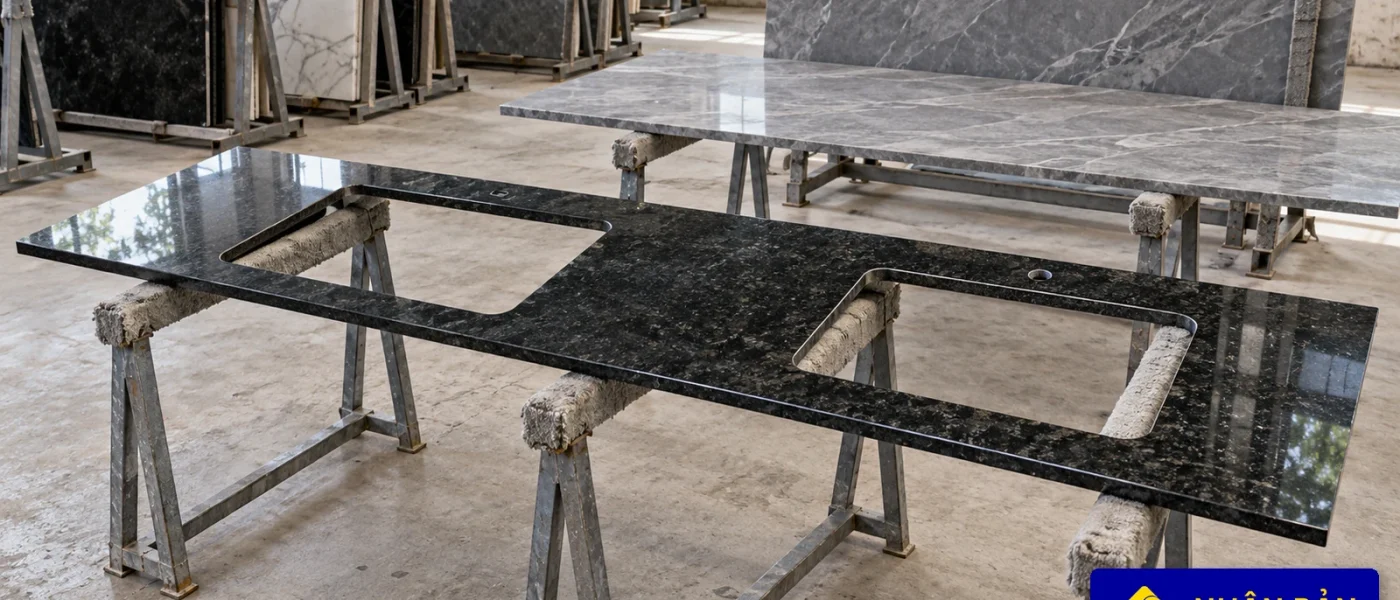
At our workshop, cooktop openings are routed via CNC with smooth radiused internal corners, distributing thermal stress evenly across the stone matrix. For narrow bridge spans in front of and behind the cooktop (often only 50 mm – 70 mm wide), our workshop embeds concealed steel reinforcement bars bonded with structural epoxy along the slab underside to prevent breakage during handling, transport, and installation.
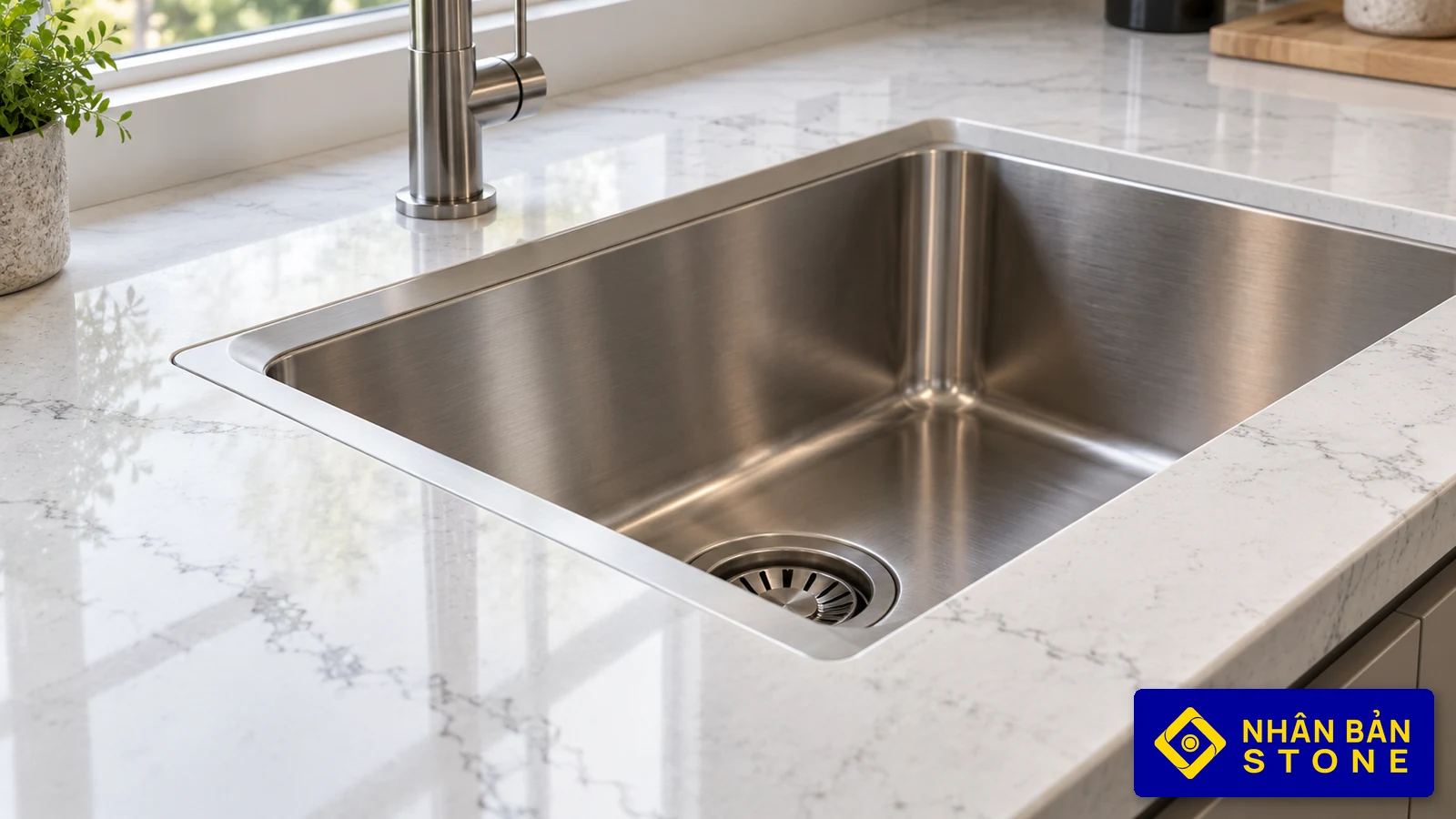
3. Kitchen Sinks: Undermount, Flush-Mount, or Top-Mount?
- Top-Mount (Drop-in): Simplest to fit, but the raised perimeter metal lip traps crumbs and dirty dishwater, making wiping counters into the sink difficult.
- Undermount: The stone slab extends over the sink rim, allowing food debris and water to be wiped directly into the basin. The exposed internal stone rim must be CNC-routed, water-polished, and softly chamfered.
- Flush-Mount: The stone perimeter is stepped down so the stainless steel rim sits level with the stone surface. Extremely sleek, but requires micro-precision CNC rebates matching the exact sink model.
Regardless of mounting style, a watertight seal between stone and sink flange is vital to prevent moisture from dripping into cabinetry carcasses below. For this reason, our workshop always requires the exact sink model specifications before programming cutouts.
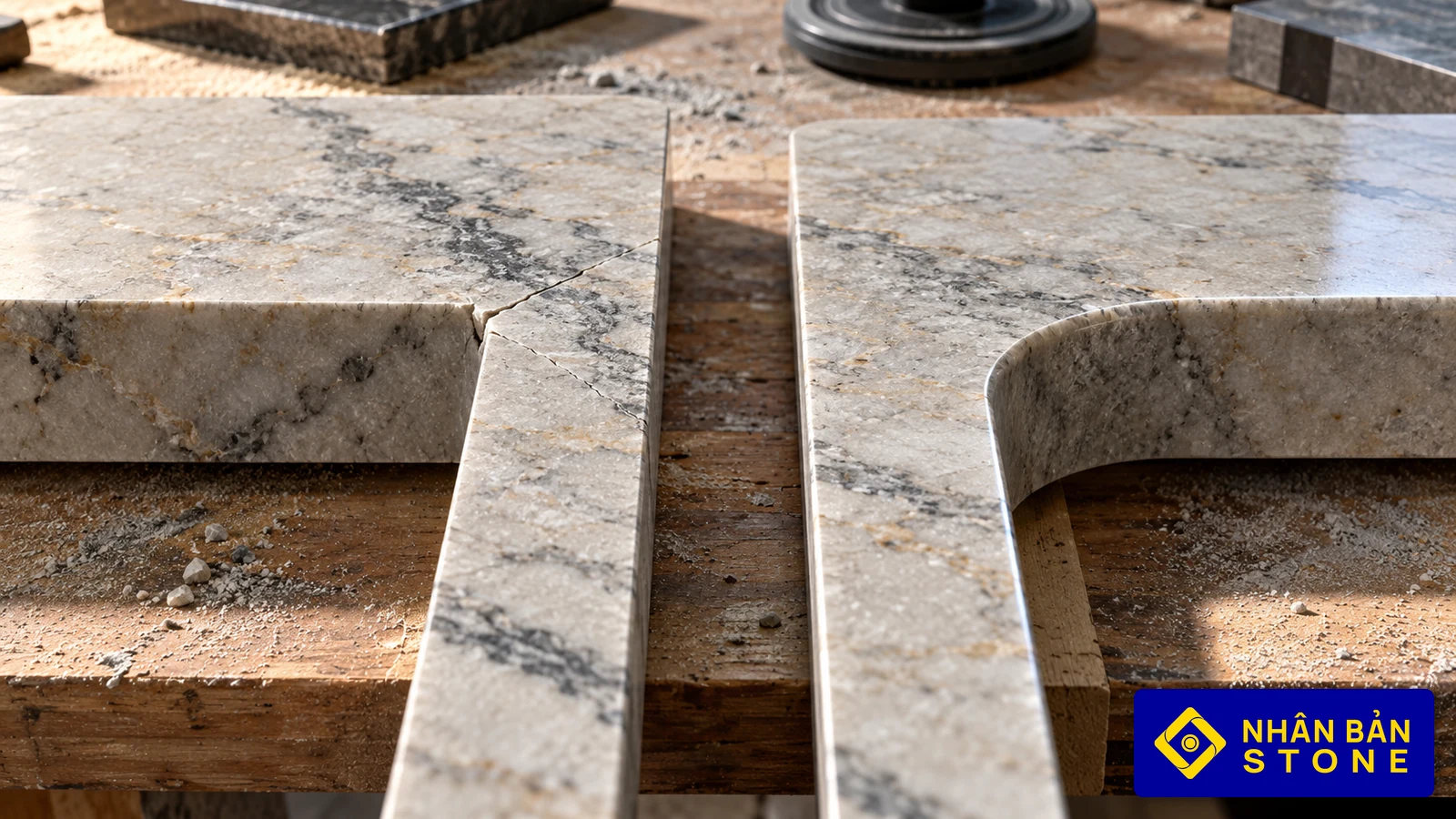
4. Seam Placement & 45-Degree Mitered Drop Edges
L-Shaped and U-Shaped Seams: Extended kitchen runs inevitably require joining multiple slab segments. Seams must be strategically positioned (avoiding fragile bridges immediately adjacent to cooktops or sinks) with veining choreographed to flow naturally across the joint. Seam locations are reviewed and confirmed on CAD drawings prior to cutting.
45-Degree Mitered Drop Aprons: To achieve a commanding 40 mm – 50 mm thick perimeter appearance from standard 20 mm slabs, stone edges are sawn at 45-degree bevels and joined with color-matched structural epoxy. When executed properly, veining cascades seamlessly from the top surface down over the edge face, rendering the joint line virtually undetectable while offering far greater impact resistance than conventional stacked laminations.
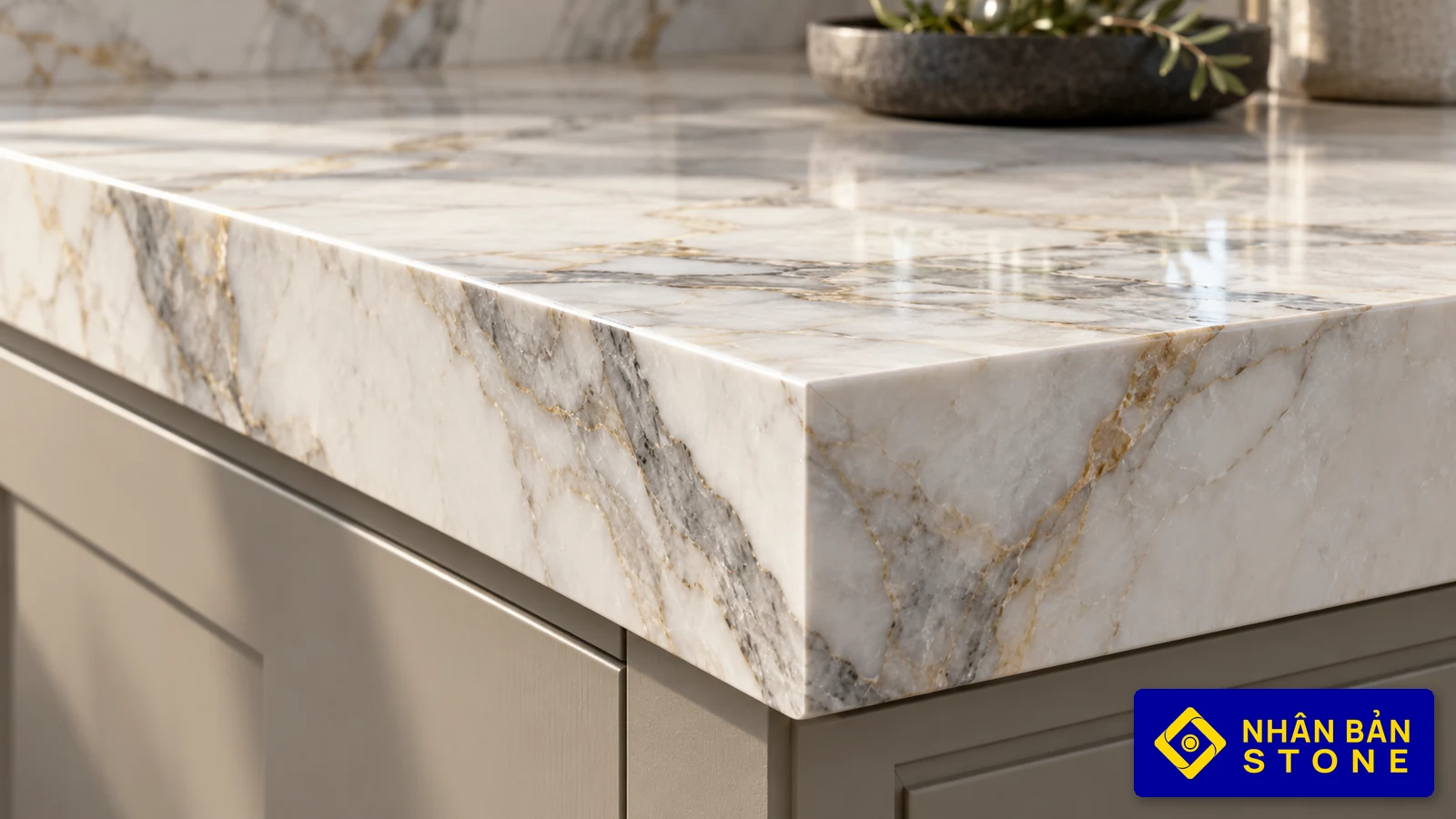
5. Waterfall Kitchen Islands & Vertical Backsplashes
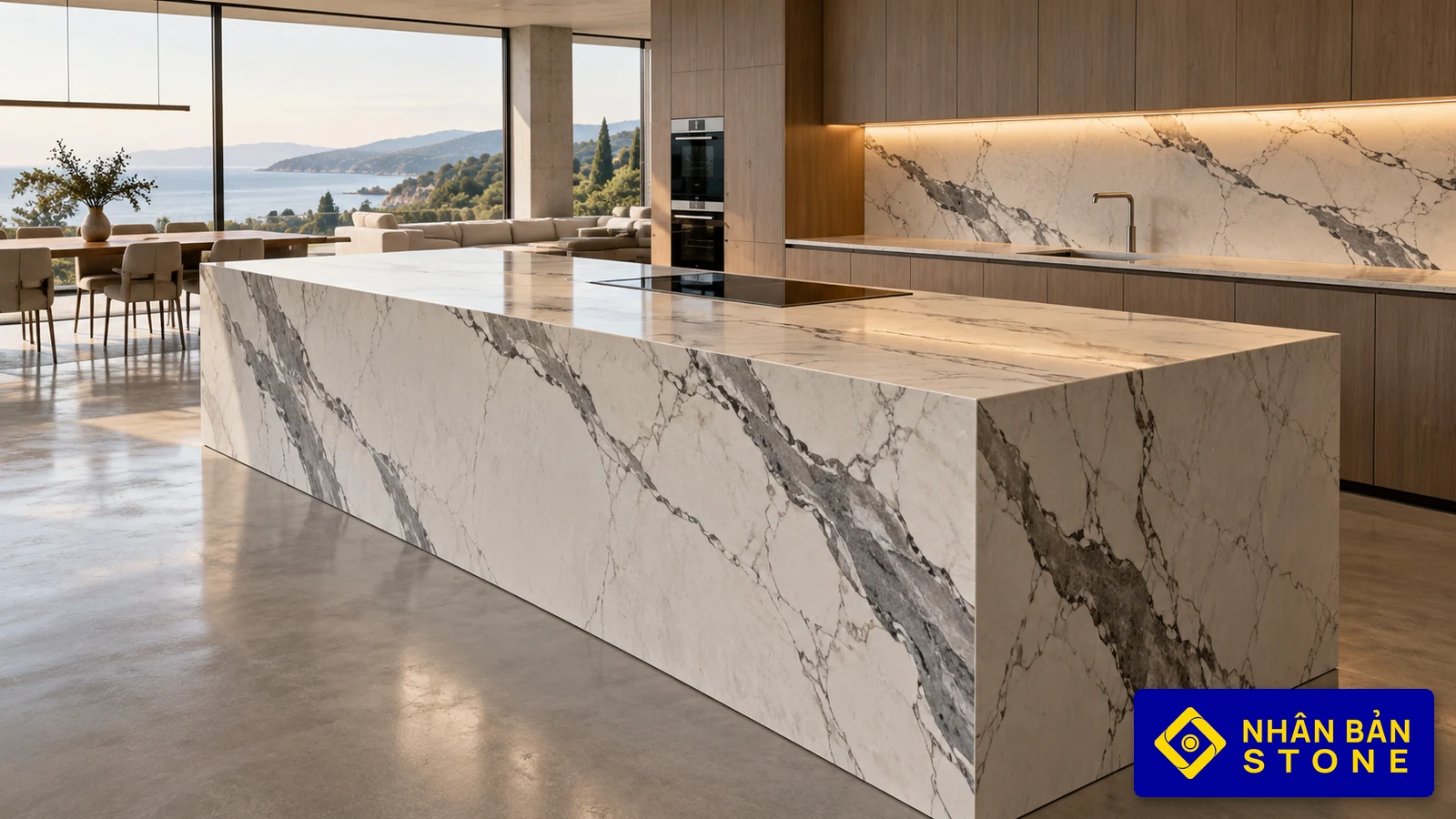
Waterfall Island Ends: The countertop surface turns 90 degrees and cascades down to the finished floor at one or both island gable ends. Slabs are mitered at 45 degrees, requiring rigorous bookmatching so bold veins align across the horizontal-to-vertical plane transition.
Full-Height Backsplashes: Extending the same countertop stone up to the underside of upper cabinetry eliminates tile grout lines, providing a hygienic, wipe-clean grease barrier. Cutouts for electrical receptacles and switch boxes are cut to approved elevation drawings using a suitable fabrication method.
6. The Standard Workshop Fabrication Workflow
- Step 1 – Dimension Verification: Sizing is derived once base cabinet carcasses are fully installed and leveled, based on approved drawings or physical template runs. On-site dimension checks require a separate agreement.
- Step 2 – CAD Shop Drawings: Layout of cooktop, sink cutouts, seam locations, and edge details. For heavily veined slabs, digital slab photos are overlaid with cutting nests for client approval.
- Step 3 – CNC Cutting, Routing & Reinforcement: Precision bridge sawing, cutout routing with radiused corners, and structural rod bedding along narrow bridges.
- Step 4 – Mitered Bonding & Dry Assembly: 45-degree mitered fascia bonding, multi-stage water polishing, and surface sealant treatment. Critical seam fits and vein flow are dry-assembled at the facility.
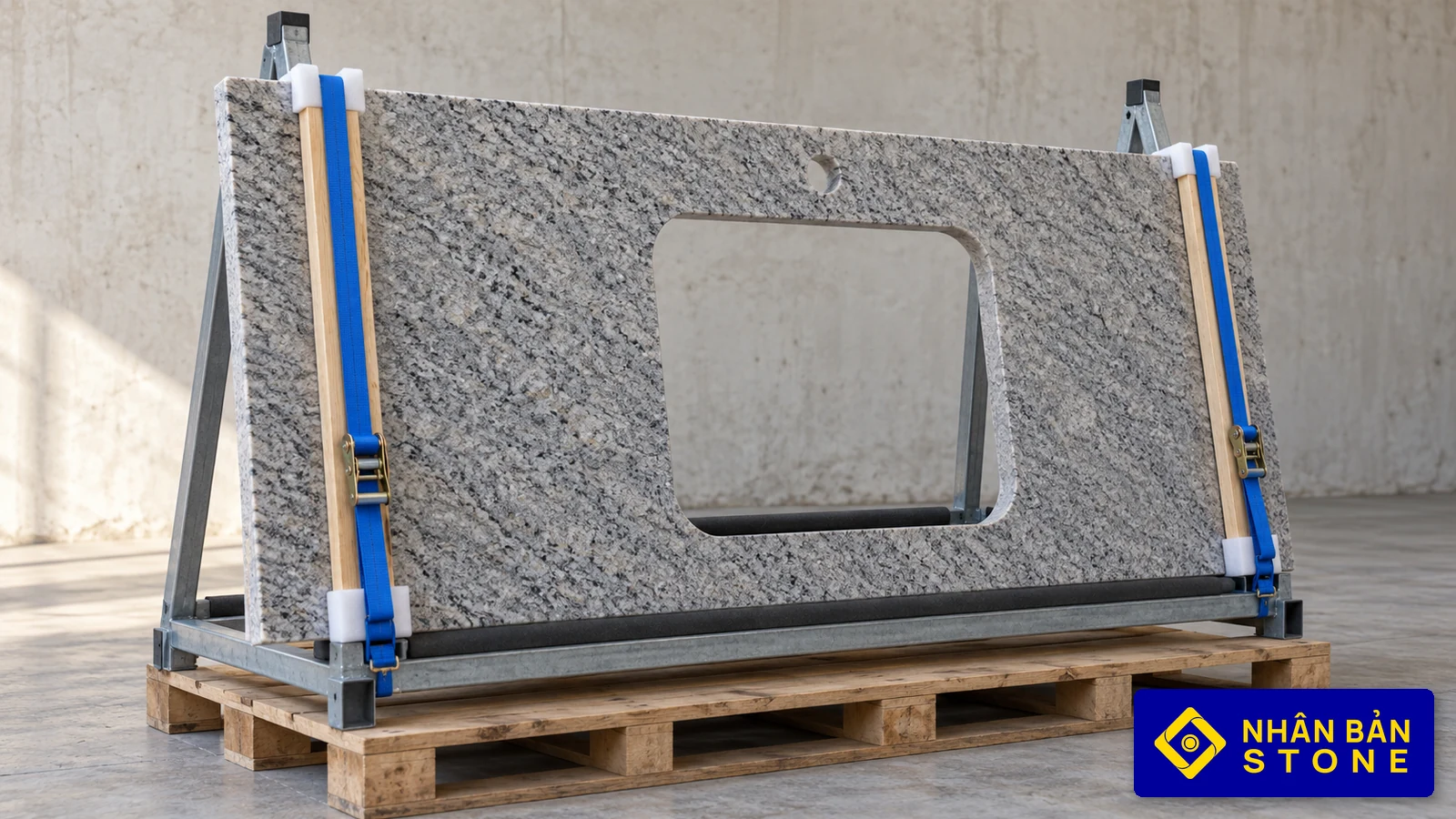
- Step 5 – Protective Packaging & Crating: Countertop runs are wrapped with foam sheets, edge-guarded, and secured upright on timber A-frames for safe transit.
7. Partnership with Cabinetmakers & Interior Contractors
- Fabrication from Cabinetry CAD Files: We ingest .dwg/.dxf files, locating appliance cutouts, sink centerlines, and overhang dimensions exactly as engineered.
- Itemized Quotations: Raw slabs per m², linear meter cutting, cutouts, 45-degree mitered aprons, and reinforcement are broken out clearly for transparent budgeting.
- Engineered Crating: Cutout-weakened countertop runs are packaged vertically on A-frame pallets to reduce the risk of damage in transit.
- Scope Definition: Standard scope comprises factory fabrication, inspection, and crated delivery; site installation coordination is detailed explicitly in contracts.
8. What Information to Provide for an Accurate Quote
- Kitchen layout drawing or run dimensions (linear, L-shape, U-shape, or island).
- Specific cooktop and sink model numbers (or cutout dimension cut sheets).
- Preferred stone variety or reference aesthetic images.
- Visible edge profile (standard 20 mm single edge vs. 40 mm – 50 mm mitered drop fascia); backsplash requirements.
- Site location and required timeline.
Kitchen stone pricing is typically structured by stone grade and linear run length, with itemized pricing for cutouts, mitered edges, and vertical cladding.
9. Care Tips for Enduring Kitchen Surfaces
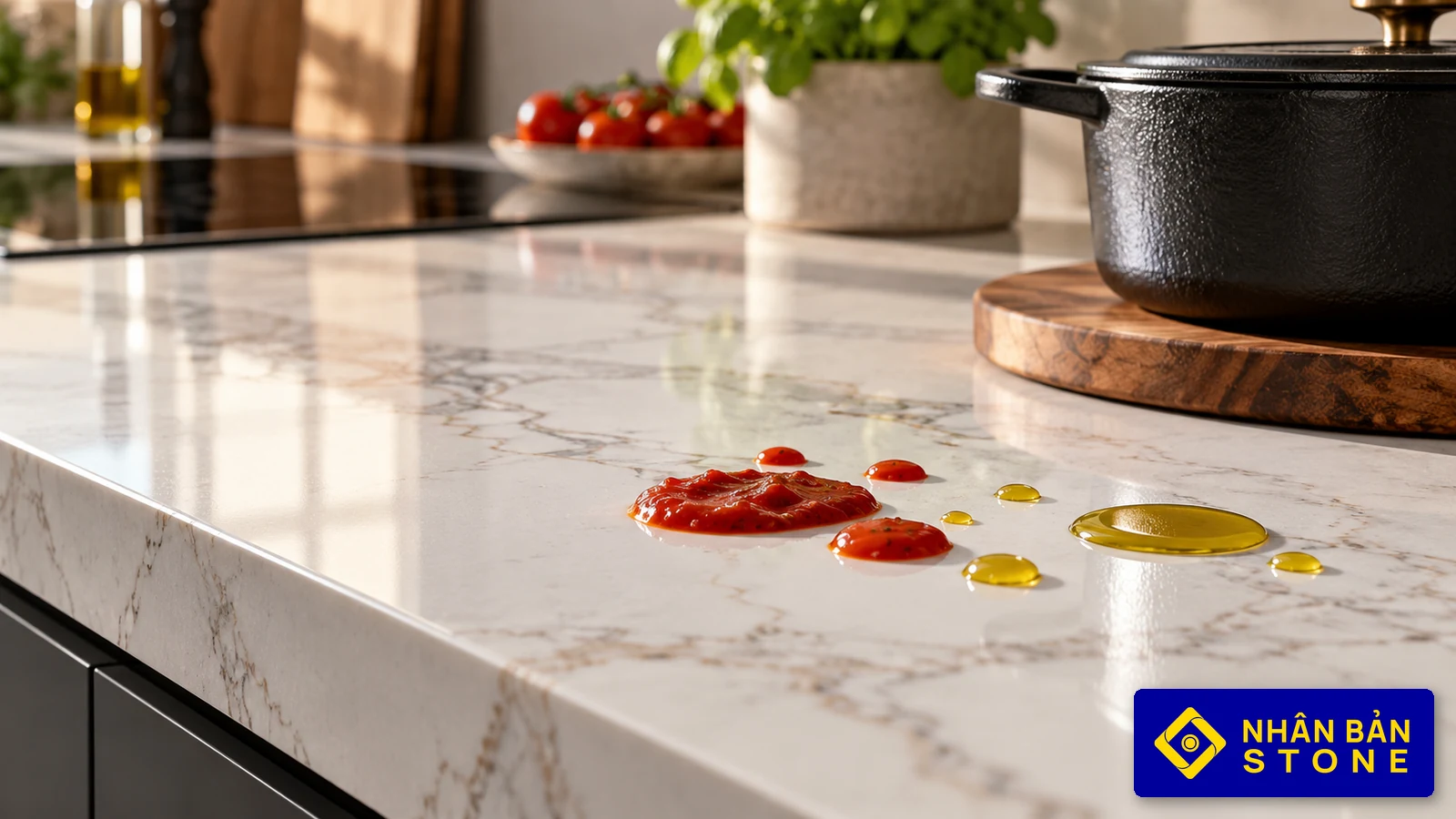
- Wipe away hot oils and food spills promptly with a damp microfiber cloth and pH-neutral soap.
- Always place hot cookware on trivets; use cutting boards rather than cutting directly onto stone.
- Avoid steel scouring pads, toilet cleaners, and strong acidic or bleach-based solvents.
10. Frequently Asked Questions (FAQ)
10.1. Which stone is best overall for kitchen countertops?
It depends on cooking frequency. For intense daily cooking with minimal maintenance: sintered stone or natural granite. For crisp, uniform white aesthetics: engineered quartz (with faithful trivet use). Natural marble is best suited for backsplashes or showpiece islands.
10.2. Can I place hot pans directly onto a stone countertop?
While sintered stone and granite offer superior thermal tolerance, rapid localized thermal shocks can cause micro-fracturing in any mineral slab. Using heat trivets is an essential habit for all stone surfaces, especially engineered quartz.
10.3. Why must we wait until base cabinets are installed before finalizing stone dimensions?
On-site walls are rarely 90-degree plumb, and installed cabinetry often deviates by several millimeters from CAD models. Verifying dimensions against leveled carcasses helps the countertop fit and reduces the need for adjustments on site.
10.4. Will an extended kitchen countertop run require a seam?
Yes, depending on available slab dimensions and geometry. Seam placement and vein continuity are confirmed on CAD shop drawings before sawing begins.
10.5. Does NHAN BAN STONE offer on-site installation?
Precision factory fabrication, quality inspection, and crating are our default scope. On-site delivery and installation services can be arranged and confirmed as distinct items within your quotation.
Contact NHAN BAN STONE Kitchen Fabrication Workshop
- 📲 Hotline / Zalo: 0909 221 083 (Monday – Saturday, 07:00 – 17:00)
- 🏢 Warehouse & Workshop: 1765 National Highway 1A, Tan Thoi Hiep Ward, District 12, Ho Chi Minh City, Vietnam
- 🌐 Explore More: Custom Stone Lavabo Vanity Fabrication · Custom Dining & Coffee Tabletop Fabrication · Architectural Surface Finishes