

The bathroom vanity top is subject to the most demanding conditions in any residential interior: persistent moisture, daily exposure to soaps, toothpaste, hard water minerals, and occasionally cosmetics or hair dyes. Common real-world failures are predictable: yellowish staining around faucet escutcheons, black stagnant grime along basin joints, diagonal stress fractures propagating from sharp cutout corners, or undermount basins detaching because they were held only by silicone sealant.
At the NHAN BAN STONE workshop in District 12, Ho Chi Minh City, we fabricate custom stone vanity countertops, wall-hung floating lavabo consoles, and integrated monolithic stone sinks tailored to exact bathroom dimensions. Basin openings and faucet penetrations are milled on precision CNC machinery per approved drawings, inner cutouts are eased so water naturally drains into the basin, and raw slabs are selected at our stone slab warehouse based on moisture resistance. Below is an engineering overview of what to establish before placing an order.
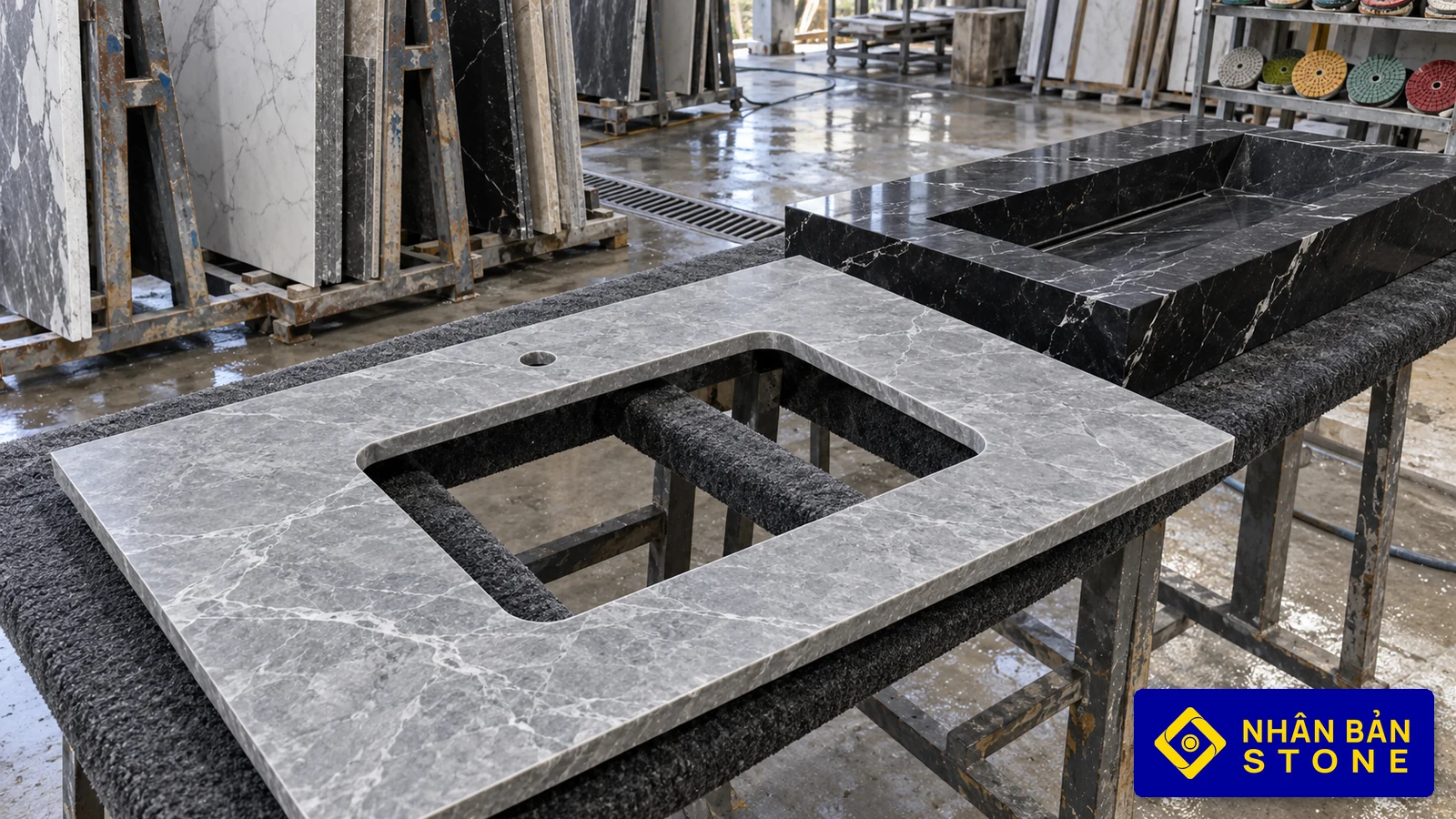
1. Choose the Basin Configuration First, the Stone Second
The type of basin dictates how the stone must be cut, milled, and structurally prepped. This choice must be locked in before sawing slabs:
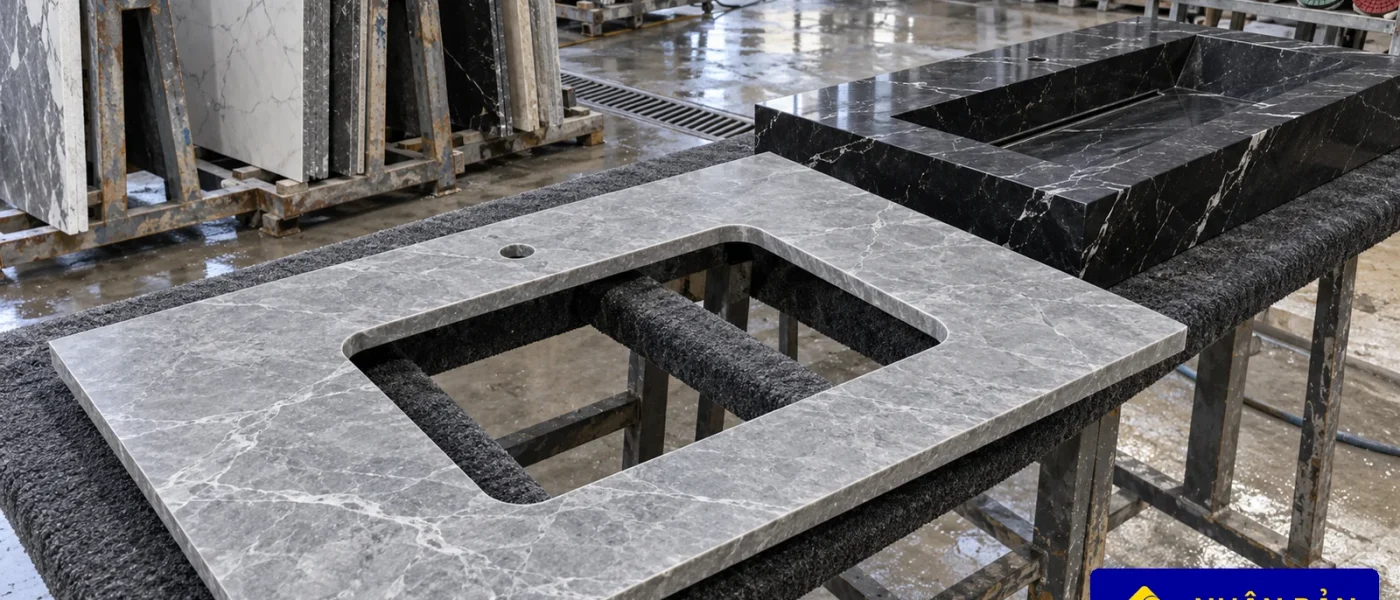
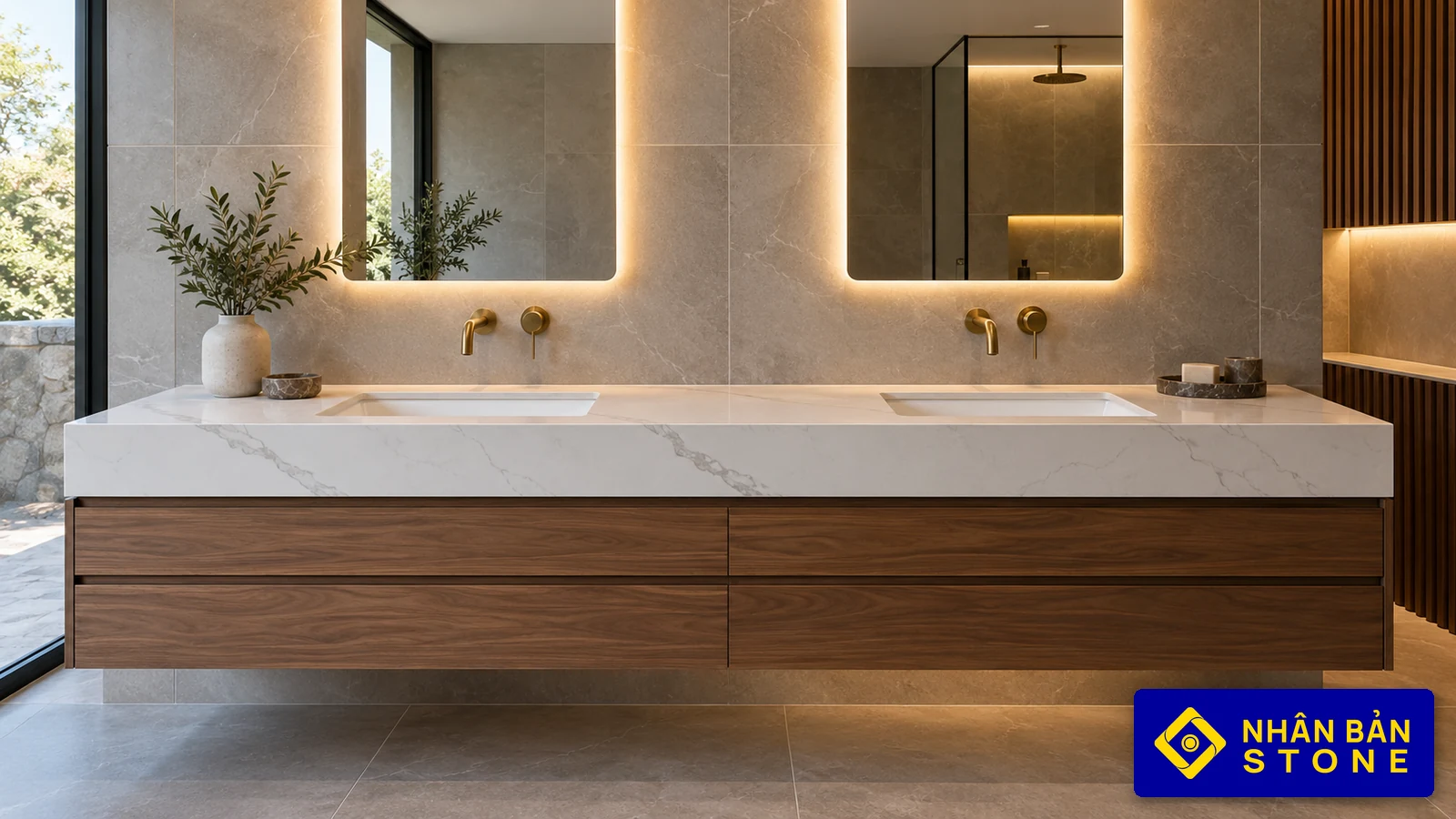
- Undermount Basin (Under-counter): The stone top extends cleanly over the basin rim, allowing water to be squeegeed straight into the bowl for effortless cleaning. Requires exact CNC cutout templates matching the basin model, with cleanly polished inner vertical faces.
- Vessel Basin (Above-counter): Ceramic or carved stone bowl sitting on top of the slab. Milling is simpler (only requiring drain and faucet holes), but faucet height and splash trajectories must be carefully coordinated.
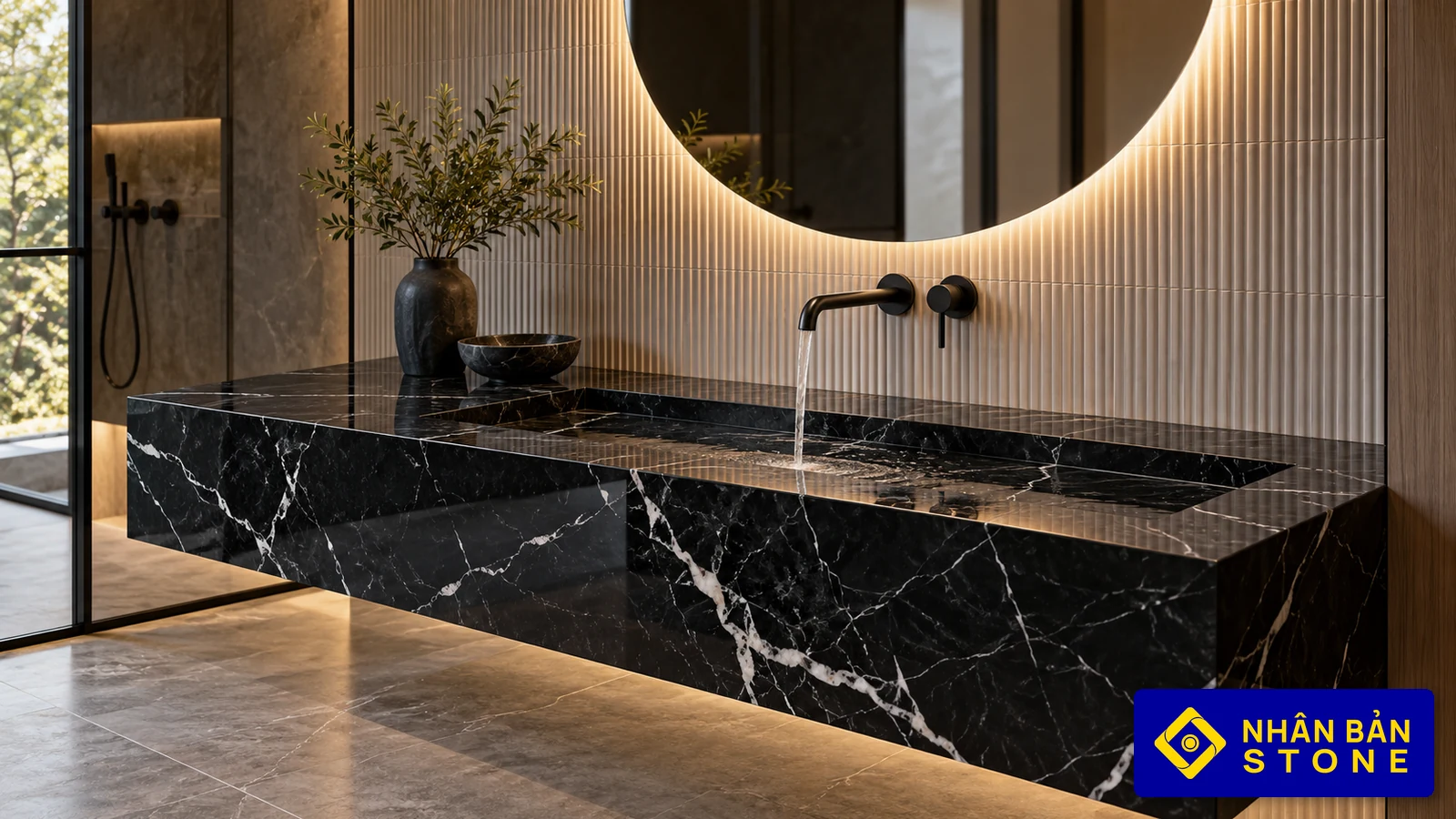
- Integrated Monolithic Stone Sink (Slot Drain / Trough): The sink basin is fabricated from the exact same stone as the vanity top, sloping subtly toward a narrow rear drainage slot with a removable matching stone cover. Visually cohesive and architectural, though fabrication is intricate and requires early coordination with the plumbing trade.
- Carved Solid Stone Basin: Sculpted from a single block of natural stone with an organic exterior and smooth honed bowl, ideal for rustic, resort, or boutique powder rooms.
Additionally, determine whether the vanity will rest on a base cabinet or be wall-hung (floating). Floating vanities require custom heavy-duty steel subframes verified by your site structural team; our workshop mills mounting slots and relief recesses according to approved shop drawings.
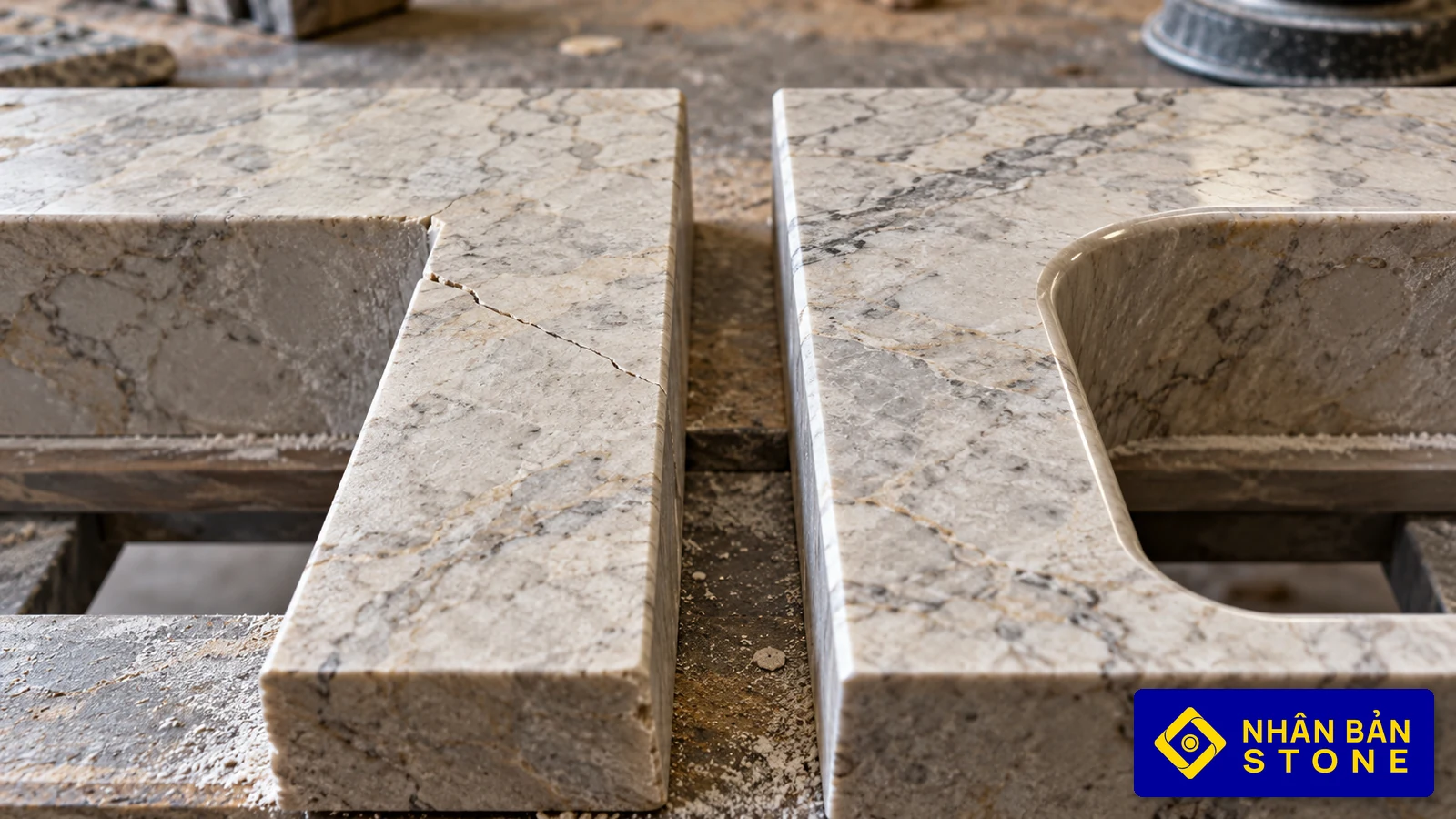
2. Why Basin Cutout Corners Must Have Radiused Transitions
When cutouts are performed manually with hand grinders, blades inevitably overshoot the corners, leaving sharp, perpendicular 90-degree notches. In structural stone mechanics, internal sharp corners act as intense stress concentrators, which is precisely where diagonal hairline cracks originate during transport or temperature cycles.
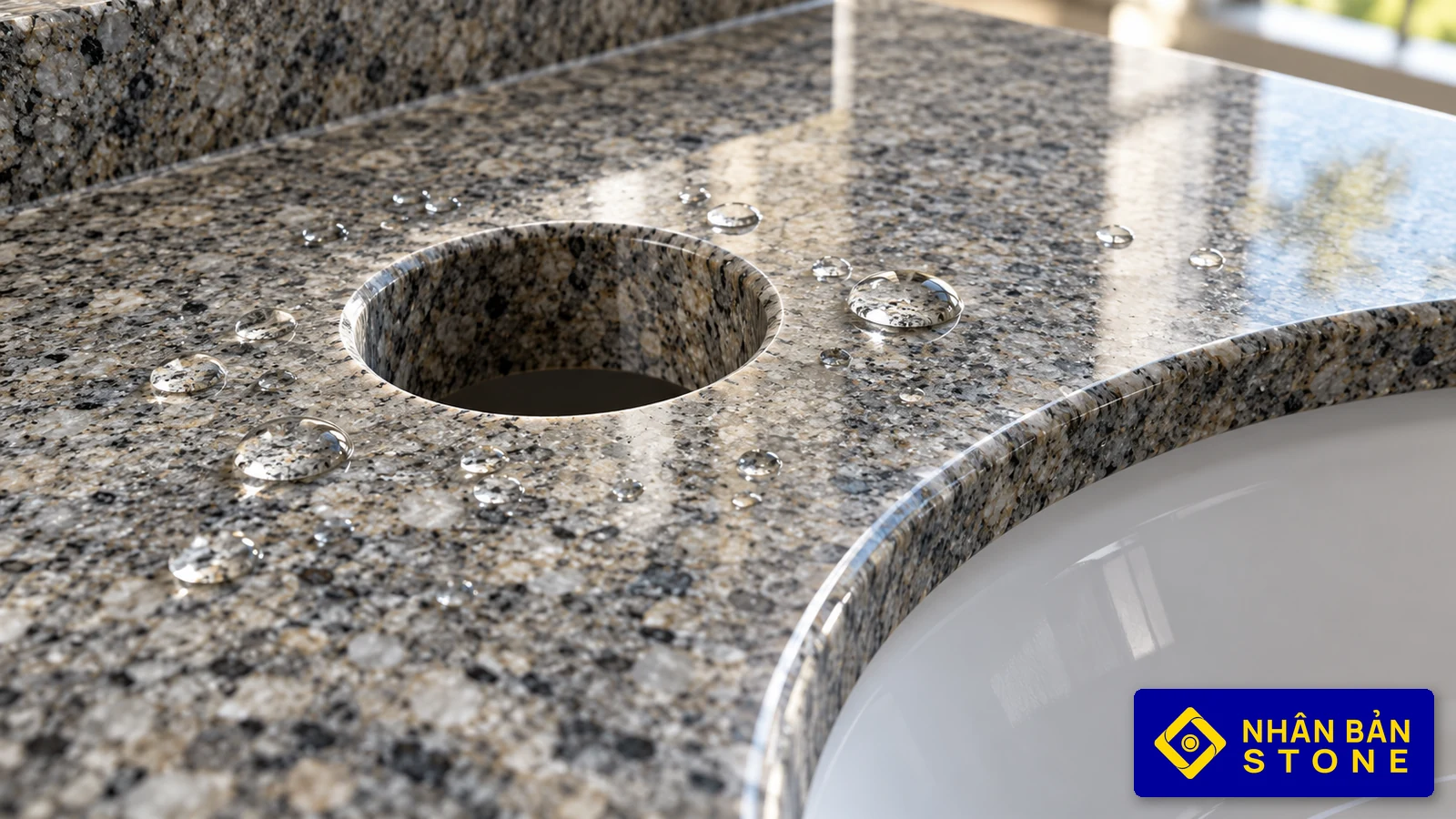
At our workshop, basin and faucet cutouts are executed on computer-controlled CNC routers with smooth radiused internal corners matching the manufacturer’s CAD profile. Inner rims are water-polished with a slight downward chamfer so water splashes drain back into the bowl rather than pooling along the seal. Faucet holes are water-jet cored cleanly without manual percussion chipping.
3. Undermount Basins Must Never Rely Solely on Silicone
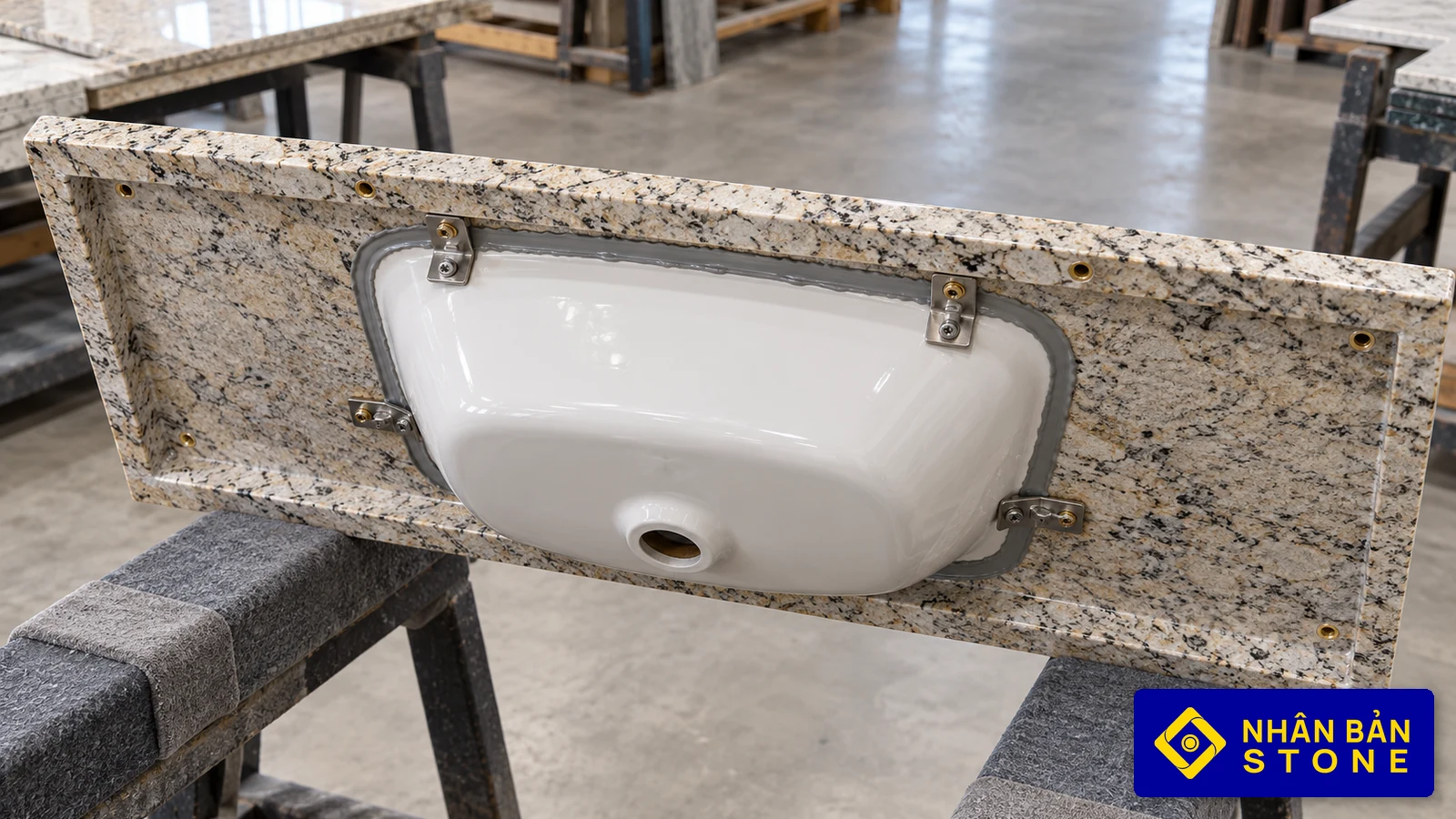
An undermount basin hangs suspended beneath the stone slab, carrying its own weight plus the hydrostatic weight of a full basin of water. Silicone sealant alone degrades over years of high humidity and chemical exposure, eventually causing the basin to sag or detach.
The engineered installation standard combines neutral-cure structural stone adhesive with mechanical stainless steel mounting clips anchored into threaded brass inserts pre-drilled into the slab underside. Anchor positions are mapped to the exact basin CAD template at our workshop, allowing installation crews on-site to bolt the basin into rigid mechanical lock.
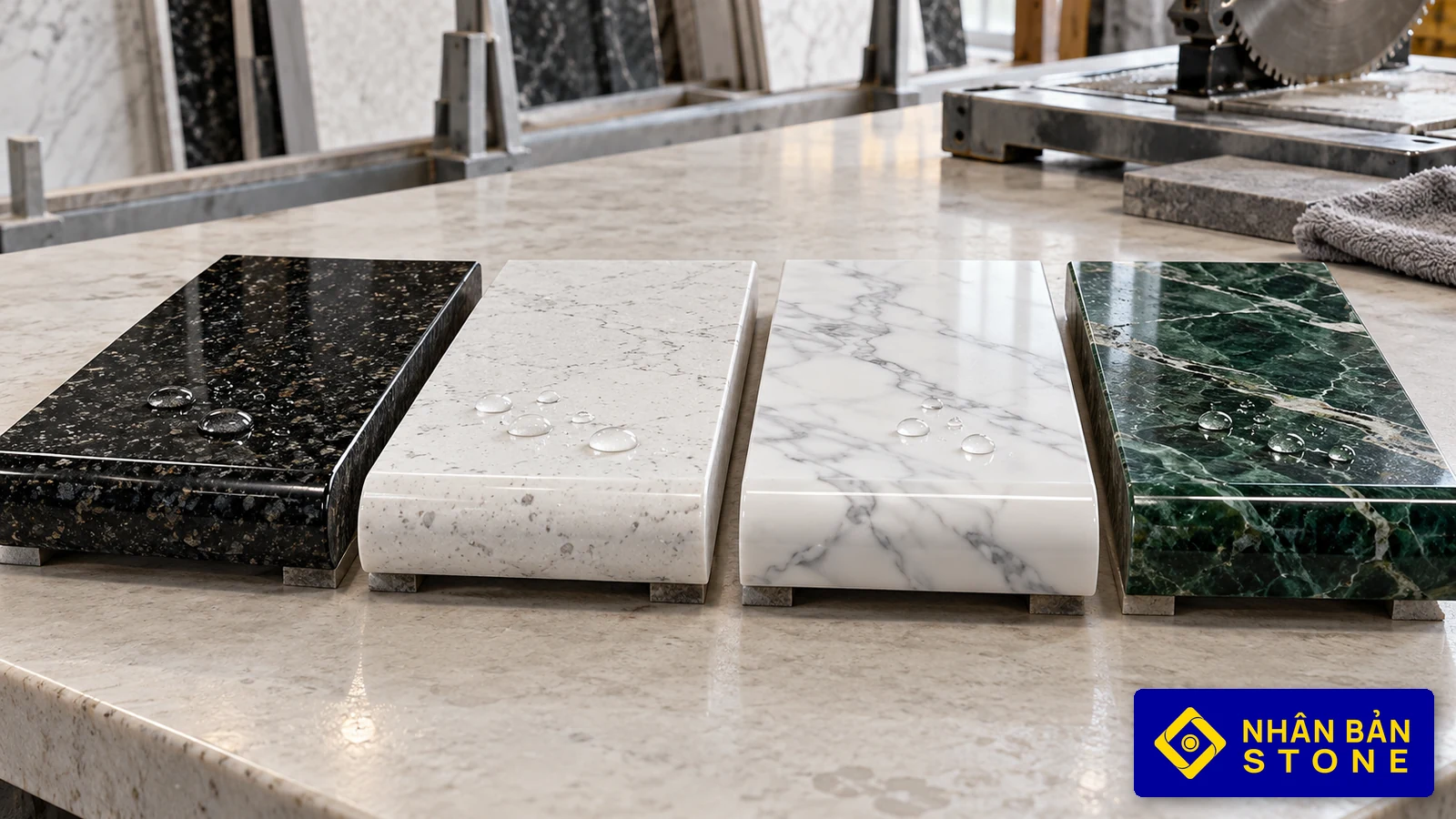
4. Which Stone Types Excel in Lavabo & Vanity Applications?
Because bathrooms experience continuous humidity, low porosity and chemical resistance take precedence over dramatic veining:
| Stone Category | Bathroom Suitability | Practical Considerations |
|---|---|---|
| Sintered Stone | Ultra-low porosity, impervious to bathroom cleansers and cosmetics | Requires meticulous CNC chamfering along basin rims |
| Engineered Quartz | Low porosity, uniform colors, pairs easily with cabinetry | Avoid prolonged contact with thermal styling irons |
| Natural Granite | Outstanding durability, scratch-proof, thrives in master bathrooms | Benefit from initial deep impregnating sealer and periodic wiping |
| Natural Marble | Luxurious, incomparable organic beauty | Acid-sensitive, susceptible to water spots if unsealed; best in guest powder rooms |
Workshop Insight: Avoid cheap, unbranded “engineered stone” composites in humid vanity settings. Low-resin mineral compounds tend to yellow and turn chalky after prolonged exposure to hot water and bar soap. If in doubt, send us your sample or reference drawing for professional material advice.
5. Popular Architectural Vanity Styles
- Integrated Monolithic Lavabo with Concealed Slot Drain: A gently sloped stone trough drains into a rear hidden channel with a removable stone cover plate, allowing easy access for hair and sediment cleanup.
- Deep Mitered Drop Apron (100 mm – 150 mm Fascia): The stone fascia drops down to conceal plumbing trapwork and water supply lines, presenting the look of a solid, floating monolith.
- Double Master Vanity Countertop: Continuous single-slab format spanning 2.0 m – 2.6 m with dual symmetrical undermount cutouts for master suites.
- Solid Hand-Carved Natural Stone Basin: Retaining the organic, textured crust on the outside while honing the inner basin to a silky, water-shedding finish.
6. The Step-by-Step Workshop Fabrication Workflow
- Step 1 – Scope Intake: Wall niche dimensions, vanity cabinet shop drawings, specific basin and faucet models, plumbing centerlines.
- Step 2 – Shop Fabrication Drawing: We generate CAD production files locating basin centers, faucet penetrations, edge profiles, and mitered aprons for customer sign-off.
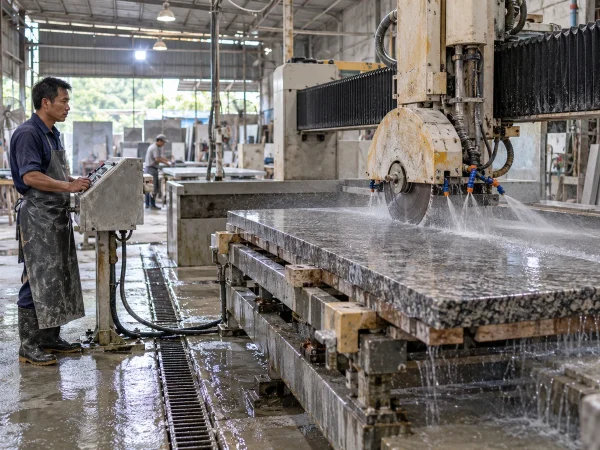
- Step 3 – CNC Cutting & Routing: Slabs are sawn, basin openings routed with radiused corners, faucet holes core-drilled, and drop aprons cut at 45 degrees.
- Step 4 – Bonding & Mechanical Pre-Assembly: Drop aprons are joined with color-matched structural epoxy, and brass threaded inserts are embedded in the slab underside.
- Step 5 – Edge Polishing & Seal Treatment: Internal cutouts and outer profiles receive multi-stage water polishing, followed by deep penetrating hydrophobic sealant application.
- Step 6 – Quality Inspection & Crating: Thorough checks on dimensional tolerances, diagonal squareness, and edge finishes; wrapped with protective film and crated in heavy timber pallets.
7. What Information to Provide for an Accurate Quote
- Overall vanity dimensions (length × depth), or architectural niche drawings.
- Basin and faucet model numbers (or specification cut sheets). This is the single most critical detail required for accurate CNC programming.
- Basin configuration: undermount, vessel, or integrated stone trough.
- Drop apron height (single 20 mm slab edge vs. 100 mm – 150 mm mitered fascia).
- Installation context: resting on cabinetry or wall-hung cantilever; preferred stone category.
For interior design firms, sanitaryware showrooms, and general contractors: we accept .dwg/.dxf files, provide itemized line-item quotations, and can calibrate cutouts directly against physical sink samples shipped to our workshop.
8. Simple Care Habits for Pristine Vanity Surfaces
- Wipe the countertop dry with a microfiber towel after use to prevent hard water mineral spotting.
- Clean periodically with warm water and a pH-neutral dish soap; rinse thoroughly and buff dry.
- Never pour chemical drain cleaners, toilet bowl acids, or hair bleaches directly onto stone surfaces; if accidental contact occurs, flush immediately with copious fresh water.
9. Frequently Asked Questions (FAQ)
9.1. Which stone is best for vanity countertops to prevent water staining?
Sintered stone and engineered quartz provide the lowest liquid absorption. Natural granite is also exceptionally durable when treated with a high-grade penetrating sealer. Natural marble is gorgeous but requires diligent wiping and periodic re-sealing.
9.2. Can I order the stone top before buying the basin?
We strongly recommend selecting and locking in your basin model first. Precise CNC cutting and undermount anchor locations must match the basin manufacturer’s exact CAD template.
9.3. Is an integrated stone trough sink difficult to maintain?
With a concealed slot drain design, the stone drain cover plate lifts out easily for regular clearing of hair and soap residue. Because the sink has no silicone rim joints, routine surface wiping is actually faster than traditional basins.
9.4. Are floating wall-hung stone vanities structurally safe?
Yes, provided the cantilevered steel framework is properly anchored into solid structural masonry or reinforced framing. The subframe must be calculated and approved by your site structural contractor; our workshop mills the stone to mate with that approved framework.
9.5. Does NHAN BAN STONE handle on-site installation?
Precision workshop fabrication, quality inspection, and crating are our standard scope. Project logistics and site installation can be coordinated and included as distinct line items in your quotation.
Contact NHAN BAN STONE Vanity Fabrication Workshop
- 📲 Hotline / Zalo: 0909 221 083 (Monday – Saturday, 07:00 – 17:00)
- 🏢 Warehouse & Workshop: 1765 National Highway 1A, Tan Thoi Hiep Ward, District 12, Ho Chi Minh City, Vietnam
- 🌐 Explore More: Custom Stone Kitchen Countertop Fabrication · Granite & Marble Warehouse · Architectural Natural Stone