

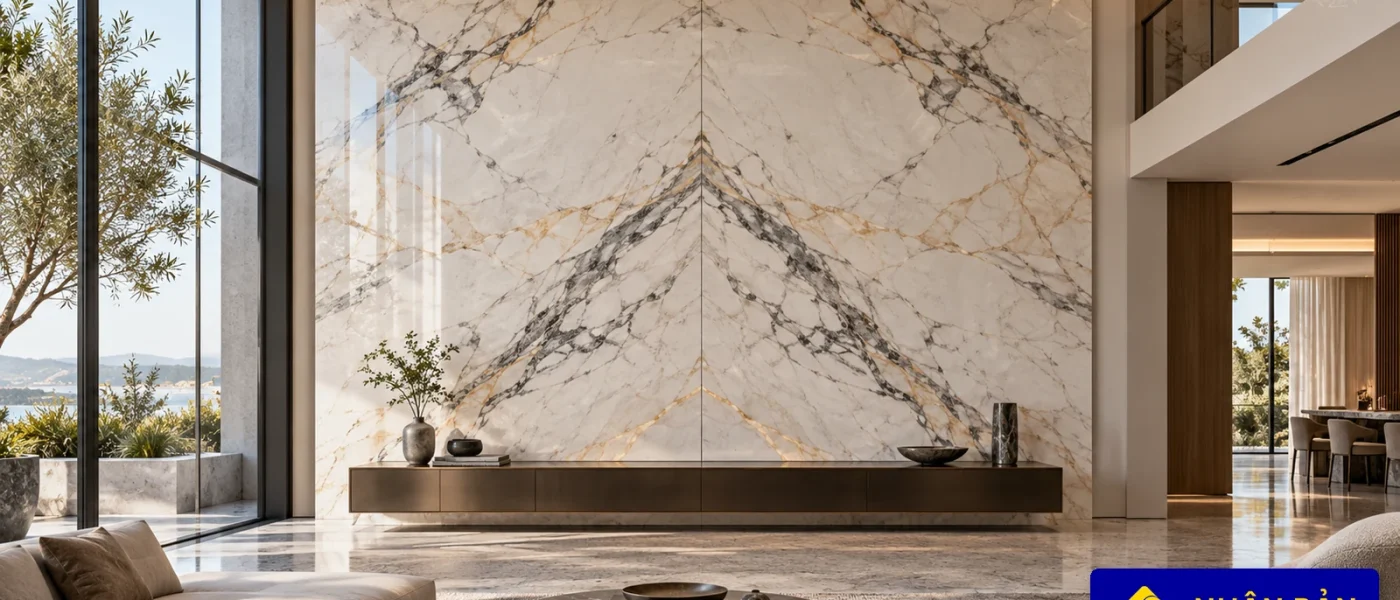
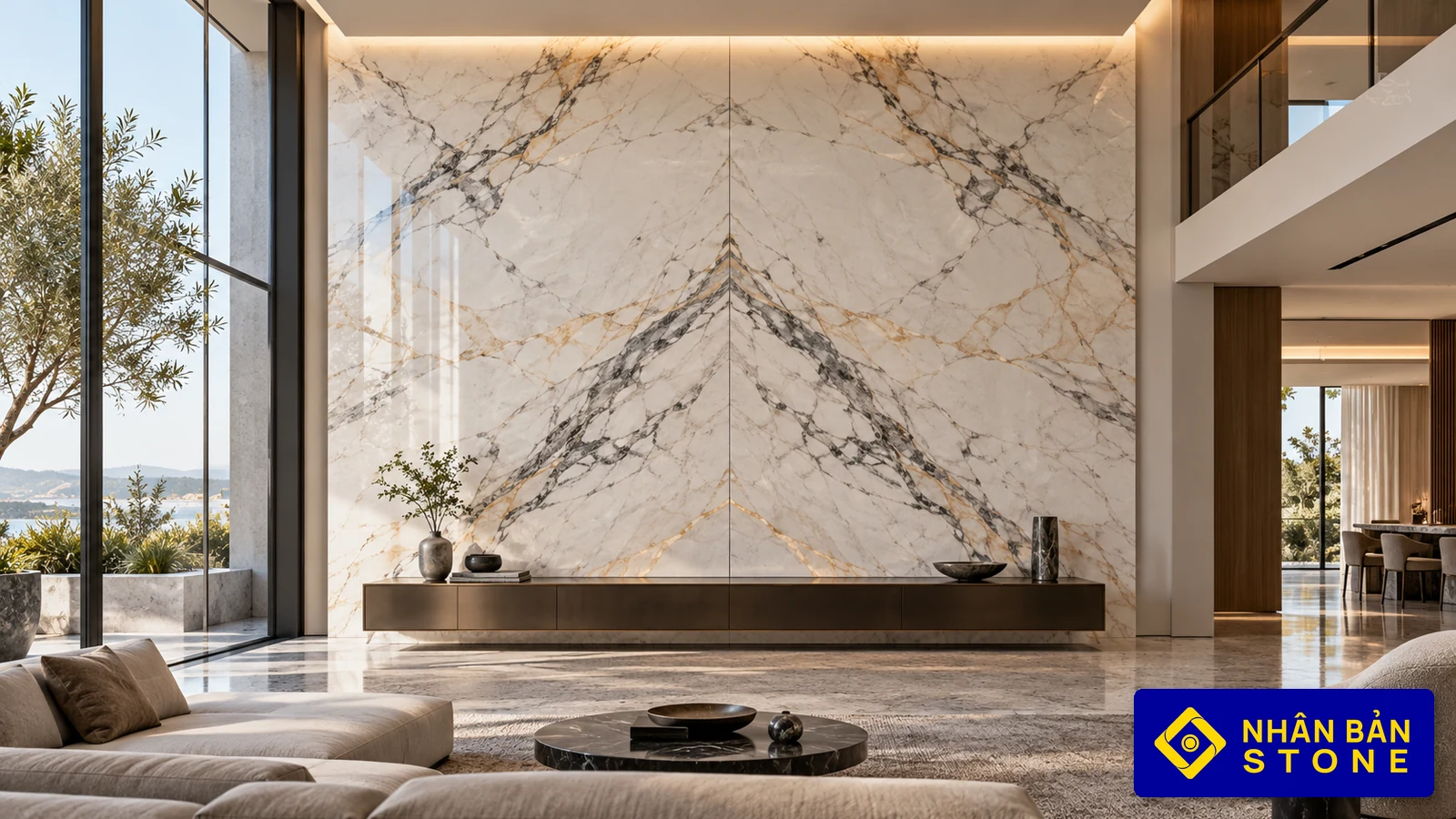
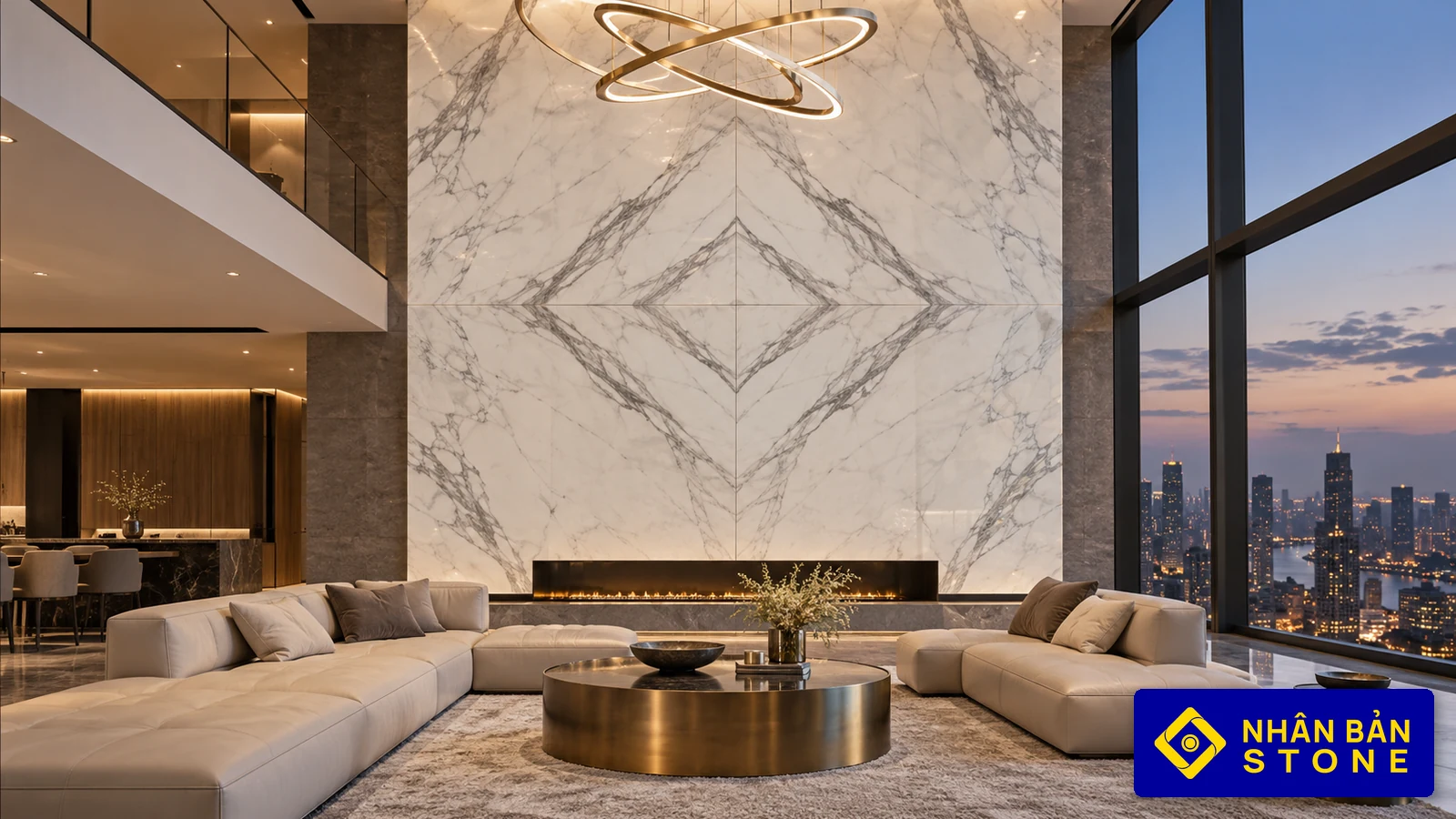
A bookmatched natural stone feature wall behind a media console or across a double-height entryway fundamentally elevates an interior space. Two adjacent slabs sliced sequentially from the exact same quarry block are polished on opposite faces and opened like the pages of a book, creating a symmetrical mineral artwork that no manufactured tile or printed wallpaper can emulate.
Achieving a breathtaking bookmatched stone wall involves far more than simply adhering slabs to a wall substrate. The most critical technical phases occur beforehand: identifying truly consecutive mirror slabs, digitally choreographing the veining prior to sawing, and machining the panels to exact wall dimensions and structural anchor points. Mismatching a single slab causes broken vein continuity along the central seam, while cutting in the wrong sector can relegate the most dramatic focal veining behind low cabinetry.
At the NHAN BAN STONE warehouse and workshop in District 12, Ho Chi Minh City, clients, architects, and designers can inspect full slab pairs in person, collaborate with our technicians on digital vein layouts, and order precision CNC-fabricated wall panels tailored to exact site elevations. This guide summarizes essential insights to establish before commissioning a bookmatched stone wall.
1. Understanding Bookmatched Stone: Terminology & Layout Types
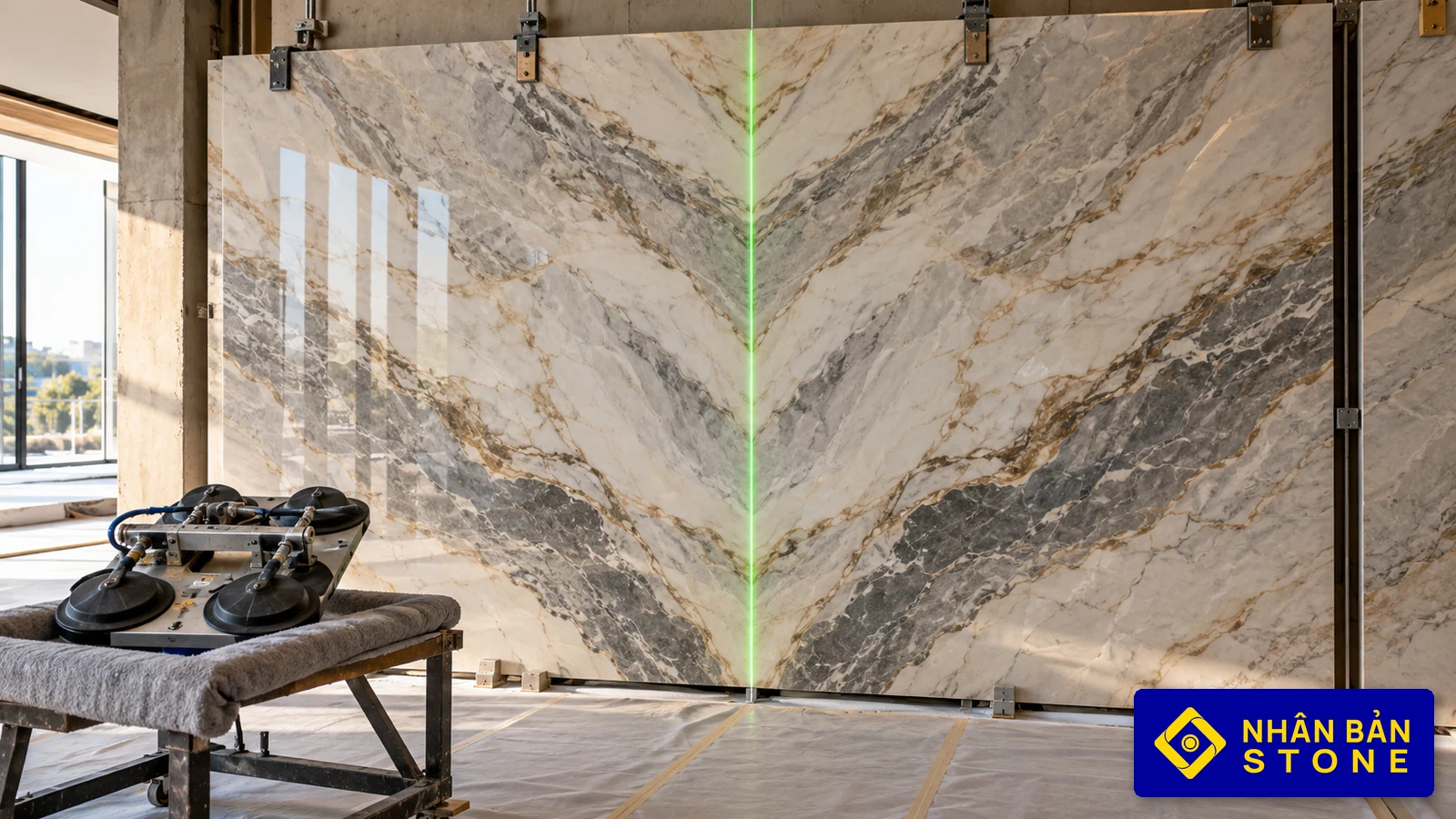
When an extracted stone block is cut into slabs by a multi-wire gangsaw, consecutive slabs emerge with virtually identical geological veining. When one slab is polished on face A and the adjacent slab on face B, and they are placed side by side, their veining mirrors each other across the central joint like an open book. This is known internationally as bookmatching.
Depending on the spatial dimensions and architectural intent, several choreographies are utilized:
- Two-Slab Bookmatch: The classic configuration, featuring two mirrored slabs meeting along a single vertical or horizontal centerline.
- Four-Slab Quad-Match: Slabs are mirrored both horizontally and vertically, creating a captivating kaleidoscopic diamond focal motif ideal for expansive, tall feature walls.
- Slip-Match (Sequential Flow): Slabs are arranged sequentially in the same orientation, creating a rhythmic, continuous directional flow rather than a mirrored reflection.
- End-Match (Vertical Stack): Slabs are mirrored along their short ends, ideal for narrow, high-ceiling columns or staircase voids exceeding individual slab heights.
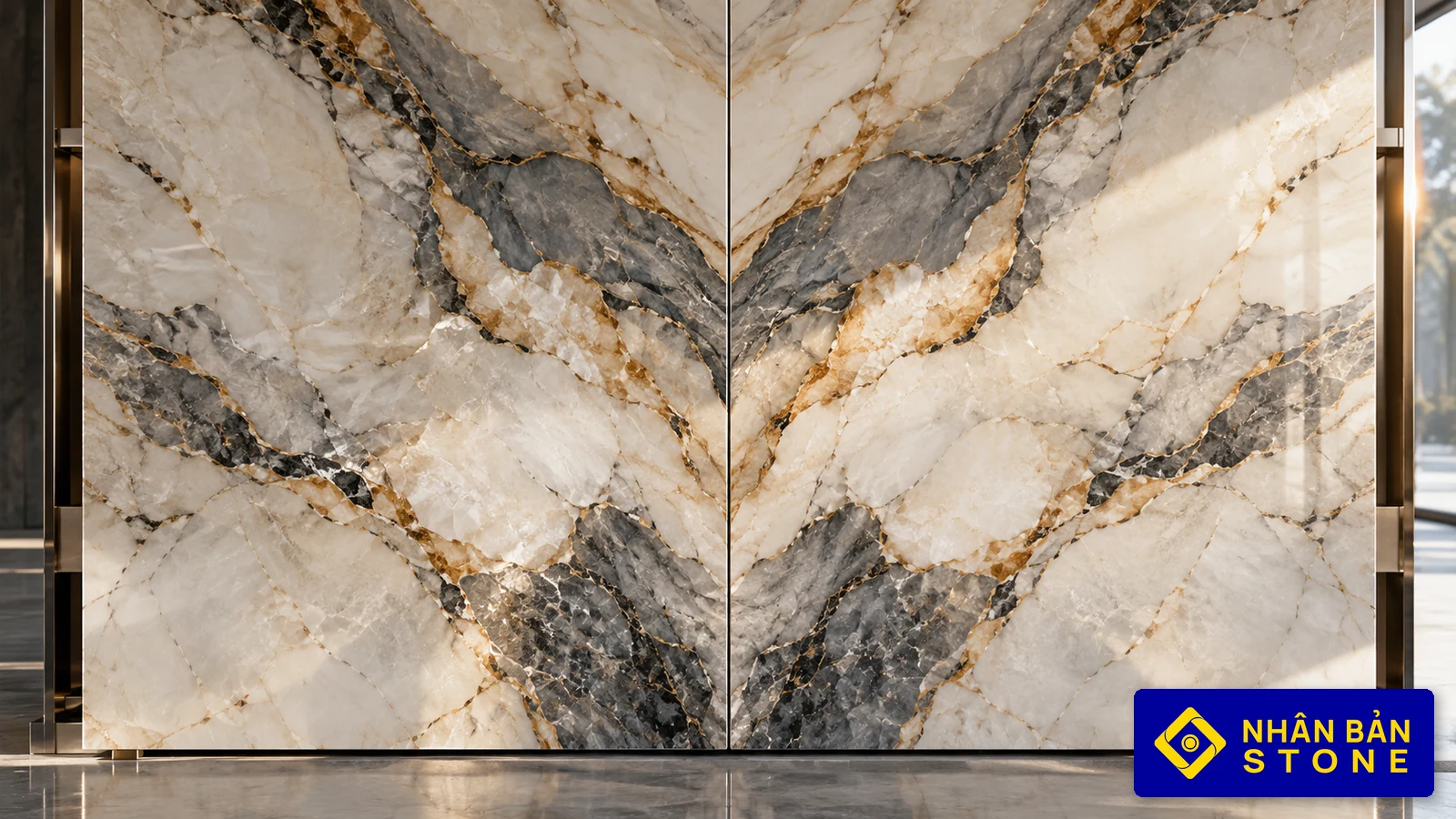
2. Selecting Bookmatched Slab Pairs at the Warehouse
Careful slab selection strongly influences the final composition. When evaluating inventory at our warehouse, keep these professional considerations in mind:
- Consecutive Block Serial Numbers: Slabs must bear consecutive factory numbers from the identical quarried block. Even skipping a single slice within the block can result in noticeable vein misalignment along the center seam.
- Usable Slab Dimensions vs. Wall Geometry: Record the net width and height of your wall, allowing for perimeter trimmings. If the wall height exceeds the slab length, vertical transoms or secondary stone bordering must be engineered from the outset.
- Focal Vein Placement Relative to Room Eye Level: The most dramatic mineral vortex or contrasting vein crest should align with standing or seated sightlines, well clear of low media consoles, speakers, or wall-mounted displays.
- Inspect Natural Fissures & Resin Lines: Authentic natural stone frequently features crystalline mineral lines or micro-fissures stabilized at source with clear epoxy. These natural geological traits should be inspected under angled lighting.
- Inspect Physical Slabs in Person: Photography often distorts subtle undertones or crystal translucency. We warmly welcome clients to inspect full slab bundles on our heavy A-frames under natural daylight.
Available pairs evolve with imported shipping containers. Please book an appointment or request full-resolution video walk-throughs of currently available inventory.
3. Digital Vein Layout Before Cutting: The Critical Pre-Production Step
Before running raw slabs through our CNC saws, our technicians photograph each slab under calibrated lighting and overlay the digital CAD boundaries of your wall directly onto the imagery. This pre-visualization allows you to approve:
- Which sector of the veining sits at the visual center, and what perimeter margins are trimmed away.
- Exactly where the central seam falls relative to wall sconces, floating cabinets, electrical outlets, and media mount points.
- How the overall symmetrical butterfly pattern reads across the entire room composition.
Only after you have reviewed and signed off on this digital layout does physical fabrication commence. Because raw natural stone cannot be “recut” after sawing, this preliminary step is indispensable.
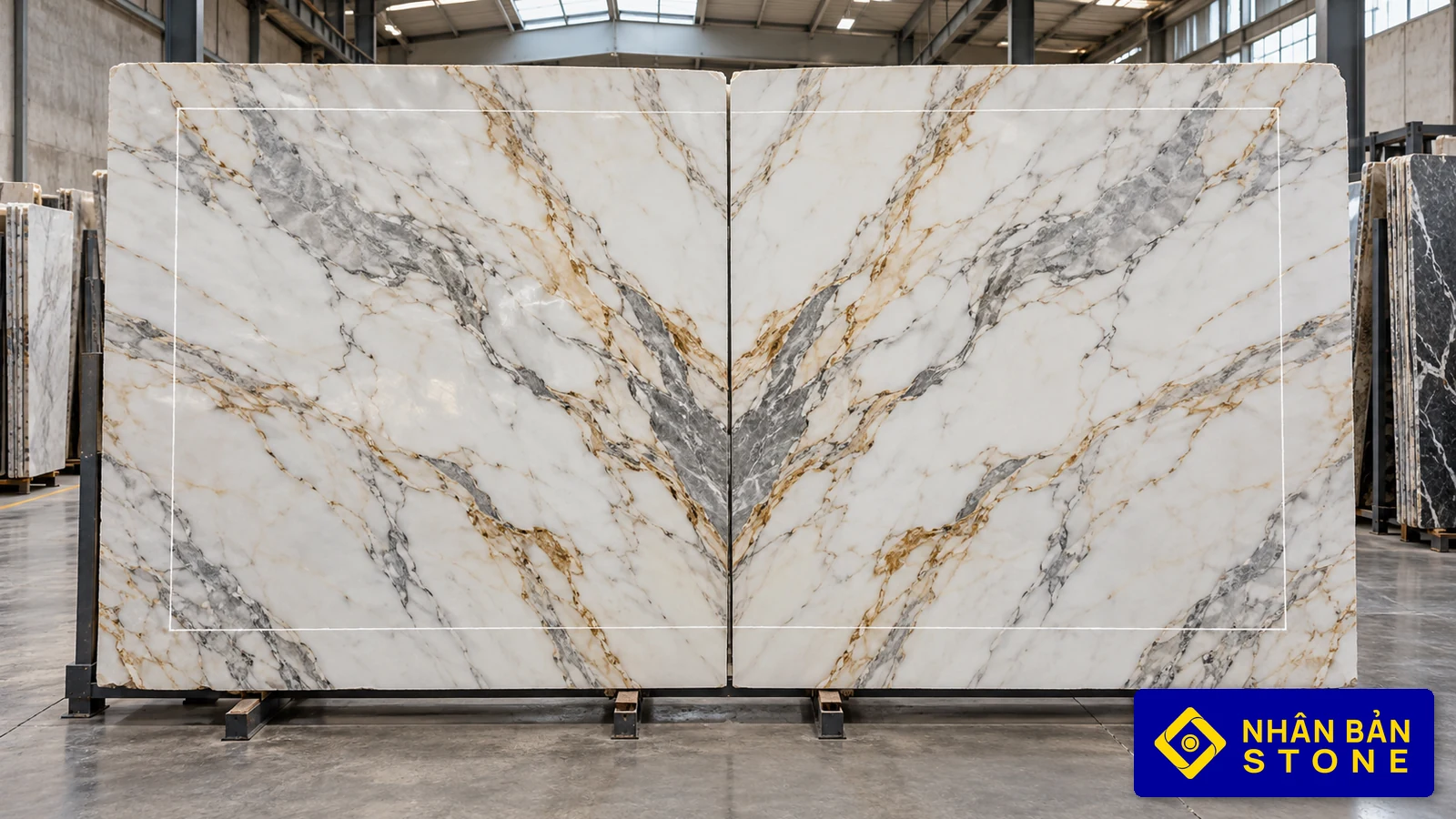
4. Primary Stone Varieties for Bookmatched Walls
- Natural Marble: Soft cloud-like veining with serene white, warm cream, cool grey, or dramatic black grounds. Marble pairs effortlessly with walnut joinery, patinated metals, and soft architectural lighting. It represents the quintessential choice for living room TV feature walls.
- Backlit Onyx & Translucent Stone: Composed of layered micro-crystals that transmit light. When illuminated from behind, warm honey, celestial jade, or creamy white veining glows from within. Light transmission varies by mineral density and slab thickness.
- Natural Quartzite: Renowned for bold, dynamic geological formations containing translucent quartz patches, dark mica clusters, and metallic copper-gold veining. Elite varieties like Patagonia provide unmatched visual drama for luxury villas.
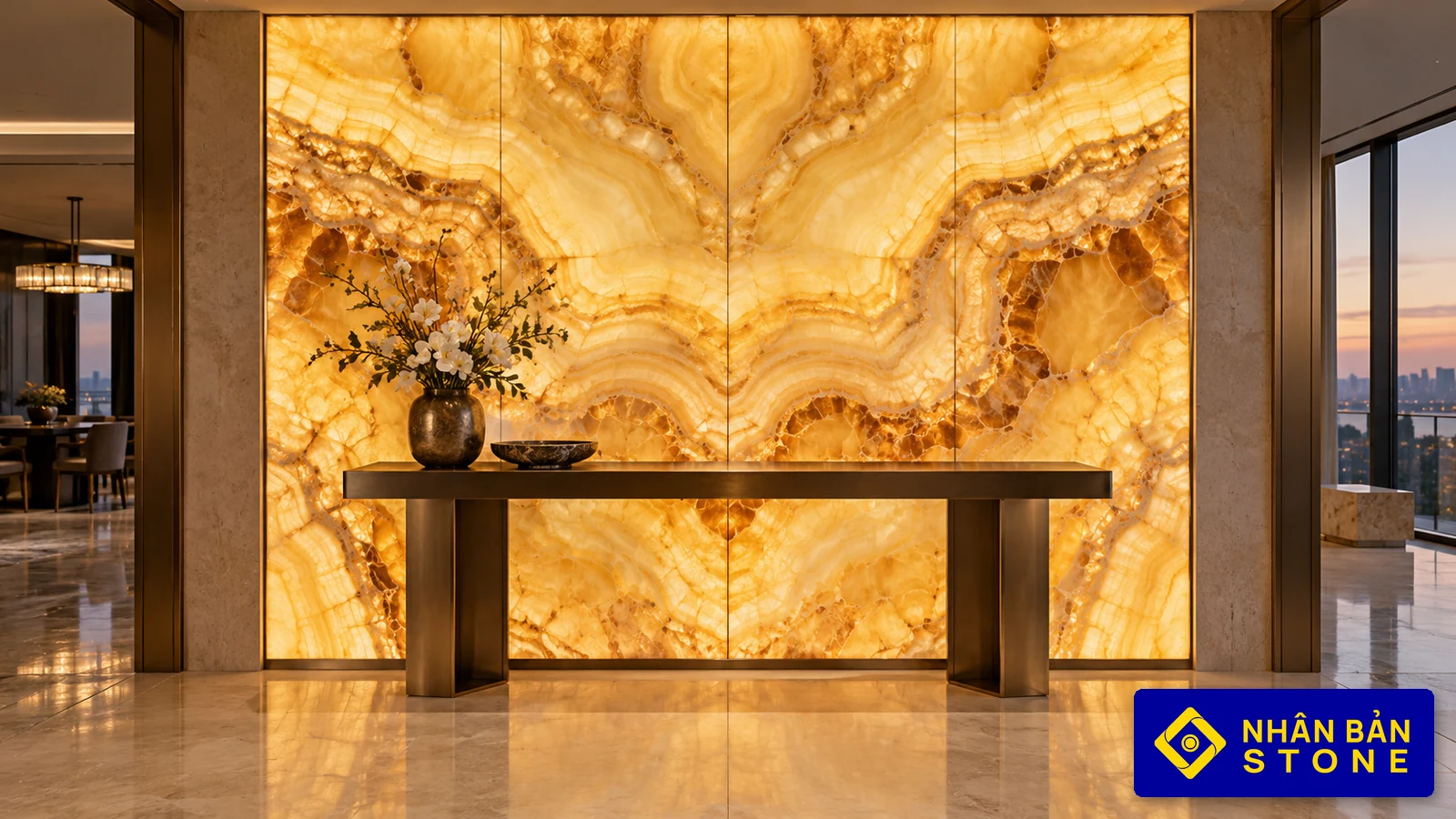
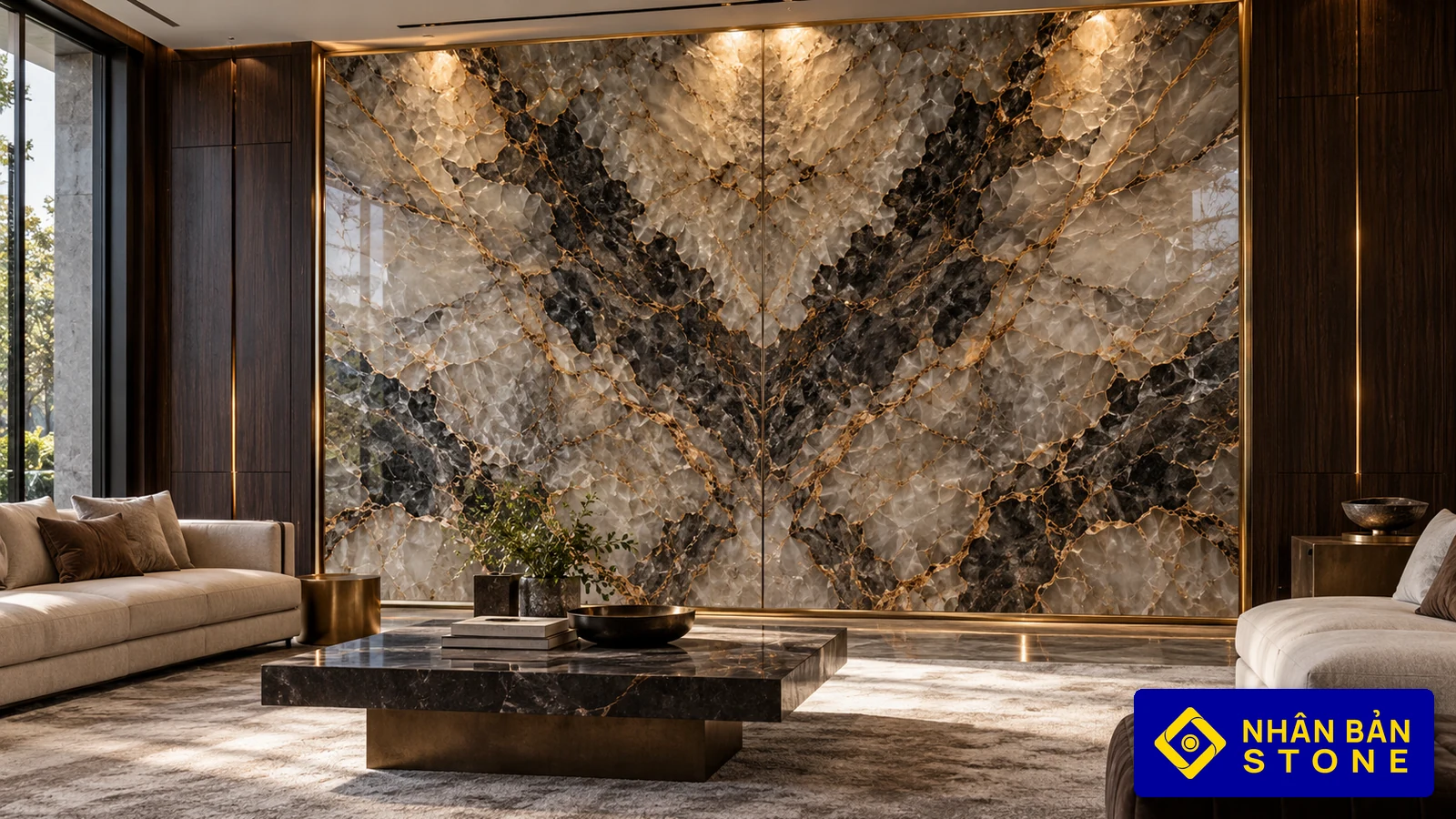
5. Large-Format Wall Mounting: Technical Prerequisites
A two-slab or four-slab bookmatched stone wall can easily weigh hundreds of kilograms. Engineering the anchoring methodology cannot be deferred to on-site guesswork:
- Substrate Structural Verification: Solid reinforced concrete, red clay brick, and drywall partitions each require completely distinct subframe anchors and load calculations. The subframe must be calculated and approved by your site structural team.
- Workshop CNC Milling for Mechanical Cleats: Rear kerfs, anchor slots, and mounting holes for mechanical split-cleat brackets are CNC-milled at our workshop according to approved shop drawings, ensuring rapid, millimeter-precise dry hanging on-site.
- Lighting Cavities and Maintenance Access for Backlit Stone: LED light fixtures must sit at an adequate offset distance from the stone to diffuse hotspots evenly. Drivers and power transformers must be placed in accessible ventilation chases for future maintenance without disturbing the mounted stone panels.
- Seam Alignment: The installation team checks levels, stone faces and vein alignment against the approved installation details using suitable leveling equipment.
6. Vein Geometries & Aesthetic Themes
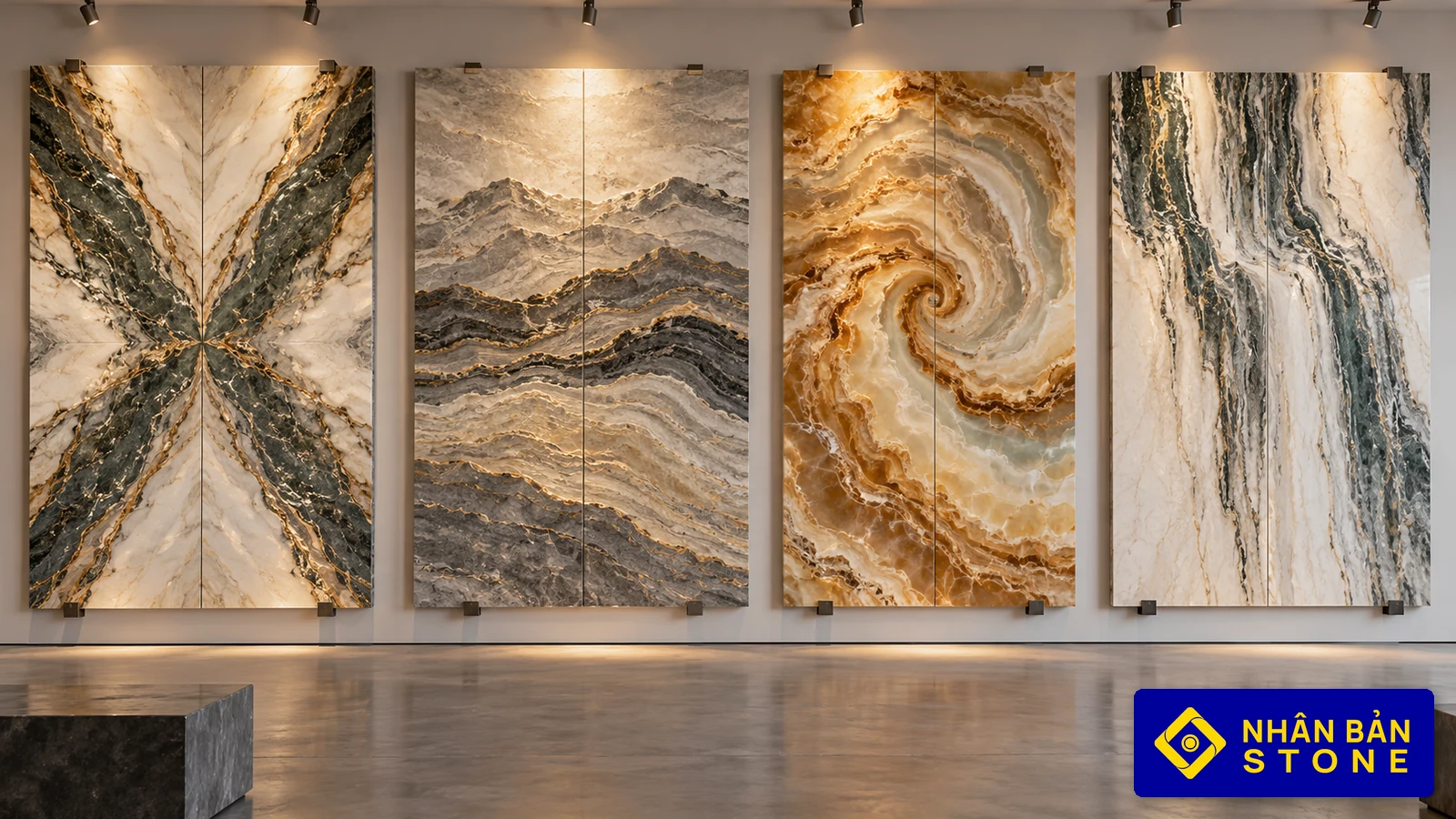
Many homeowners select bookmatched stone compositions based on natural visual archetypes:
- Butterfly Wings: Two mirrored halves opening outward, evoking expansion, renewal, and poised symmetry.
- Landscape & Mountains (Shan Shui): Layered, undulating horizontal strata reminiscent of misty mountain ridges, traditionally favored behind sofas as an emblem of solid backing.
- Swirling Vortex: Veins converging inward toward an energetic focal center, creating a powerful conversational gravity.
- Cascading Waterfall: Diagonal veins pouring downward with dynamic vertical momentum.
These archetypes offer poetic aesthetic frameworks. The ultimate choice should always rest on the personal emotional connection you experience when standing directly in front of the physical stone slabs.
7. The Collaboration & Production Workflow
- Step 1 – Wall Specification Intake: Clear width and height measurements, architectural photos, positions of media consoles, sconces, and structural walls.
- Step 2 – Slab Pair Selection: Reviewing consecutive slab pairs in person at our District 12 warehouse, or via high-resolution photos and video walk-throughs.
- Step 3 – Digital Vein Nesting & Approval: Superimposing cutting boundaries over digital slab images to lock in seam placement and centerpiece veining.
- Step 4 – Precision Workshop Fabrication: Slabs are CNC-sawn, edge-profiled, and pre-milled for mechanical brackets. Slabs are dry-assembled at our workshop to verify mirror alignment.
- Step 5 – Numbered Crating & Safe Transit: Slabs are labeled with position codes, wrapped in protective cushioning, and secured upright on custom timber A-frames. Delivery and site installation are coordinated as confirmed in your quotation.
8. What Information to Provide for Initial Consultation & Quotation
- Wall dimensions (width × height) and site photos.
- Preferred stone category: natural marble, backlit onyx, or quartzite; desired color palette.
- Desired layout: 2-slab bookmatch, 4-slab quad-match, or continuous slip-match.
- Backlighting requirements (yes/no).
- Project location, installation floor level, and elevator/stairwell transit dimensions.
Bookmatched stone pricing is governed primarily by the rarity and provenance of the slab pair, total surface area, choreography complexity, and custom CNC machining specifications.
9. Frequently Asked Questions (FAQ)
9.1. How does a bookmatched stone wall differ from standard wall cladding?
Standard cladding uses unrelated slabs installed in tiled fashion without concern for continuous grain. Bookmatched walls utilize consecutive, mirrored slabs cut from the same quarry block, positioned so veining forms a symmetrical, unified architectural artwork.
9.2. How can I verify that two slabs are genuinely consecutive?
True bookmatched pairs bear consecutive sequential numbers stamped at the processing quarry. When stood face-to-face and opened like a book, vein paths meet precisely across the adjacent edges.
9.3. Can I view a full rendering of my wall before slabs are sawn?
Yes. Our workshop creates a digital composite overlaying your architectural wall dimensions onto high-resolution photography of the exact slabs, allowing you to approve the veining layout before cutting begins.
9.4. Do backlit stone walls require maintenance access?
Yes. LED strip lights and driver transformers have finite operating lifespans. Framing must include accessible chases or removable side trims so electrical gear can be serviced without dismantling the stone panels.
9.5. How can I distinguish genuine backlit onyx from faux printed acrylic?
Natural onyx exhibits multi-layered mineral depth, three-dimensional crystal structures when illuminated, and is cold and heavy to the touch. Printed acrylic sheets display a flat, repeated pattern. We always invite clients to inspect actual stone slabs illuminated by test light wands at our warehouse.
Contact NHAN BAN STONE Warehouse & Workshop
- 📲 Hotline / Zalo: 0909 221 083 (Monday – Saturday, 07:00 – 17:00)
- 🏢 Warehouse & Workshop: 1765 National Highway 1A, Tan Thoi Hiep Ward, District 12, Ho Chi Minh City, Vietnam
- 🌐 Explore More: Granite & Marble Warehouse · Custom CNC Stone Fabrication Services · Architectural Natural Stone