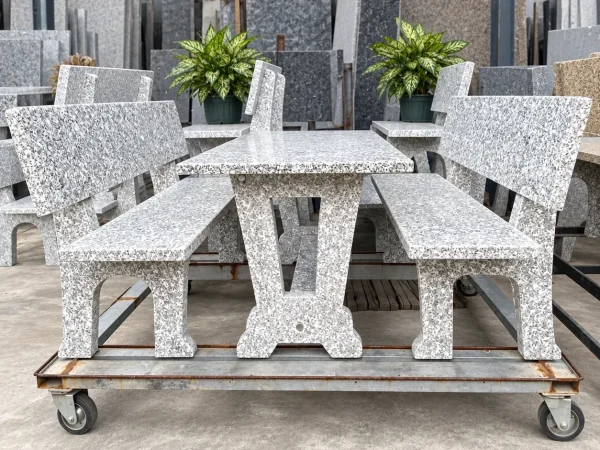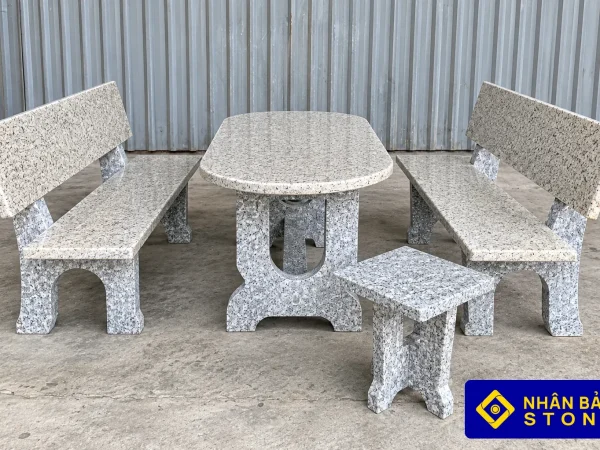


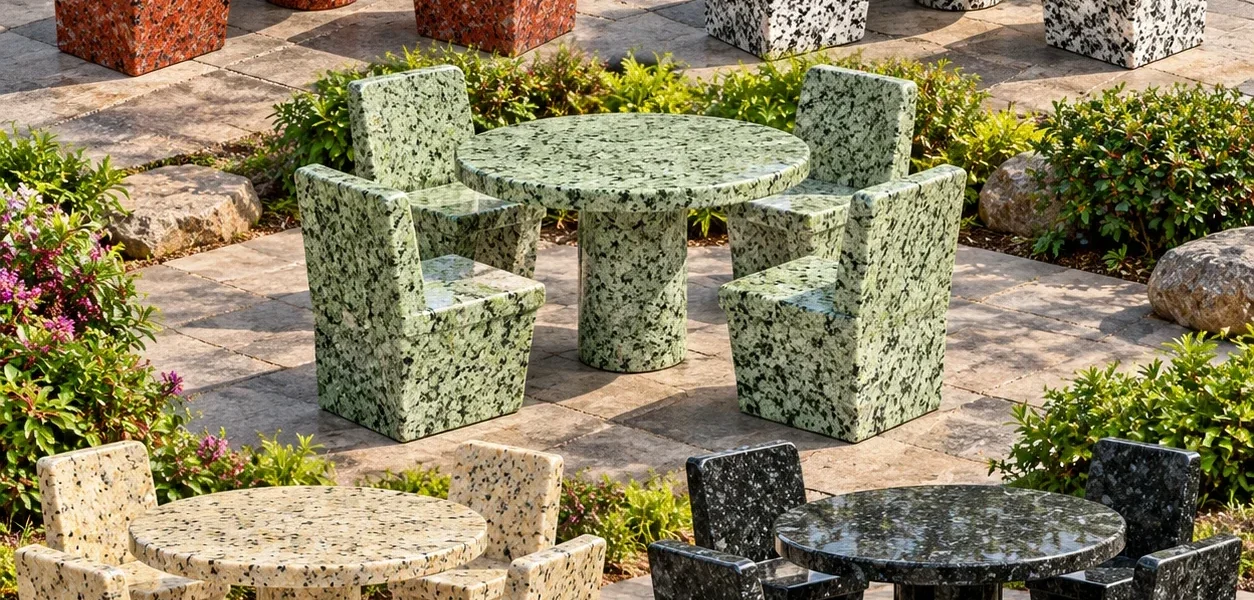
When considering public park granite bench, compare the actual surface, intended application, and installation requirements instead of relying on the trade name alone. This guide focuses on checks that can be completed before material approval.
Natural stone varies from slab to slab and batch to batch. Water absorption, strength, thickness, and load capacity should only be quoted from documentation for the specified product, alongside the approved sample and project drawings.
1. Reducing Mid-Span Fracture Risk with Concealed Steel Reinforcement
The primary vulnerability of conventional concrete or poorly constructed stone benches is transverse snapping across the mid-span. Under heavy dynamic point loads, tensile bending stresses reach peak values between the two supporting stone pedestals. You can also refer to our guide on “Natural Granite Table Sets: Anatomy, Dimensions and Engineering Standards” to compare technical suitability for your installation.
2. Standard Dimensions for Public-Project Stone Benches
To accommodate diverse public anthropometrics while preserving pedestrian walkway clearance, standardized dimensional tiers are maintained:


5. Export Timber Pallet Crating and Long-Haul Logistics Standards
All finished benches receive dual layers of heavy-duty bubble wrap and edge-protecting cardboard corner buffers to shield diamond-polished surfaces. Assemblies are strapped securely onto heat-treated, fumigated timber pallets using heavy-duty composite steel tension bands. This standardized palletized crating enables rapid, damage-free forklift handling on job sites across nationwide developments. You can also refer to our guide on “Outstanding Benefits of Natural Granite Outdoor Garden Furniture” to compare technical suitability for your installation.
Review the slab under lighting similar to the intended space, and record the vein direction, colour range, and acceptable variation between adjacent pieces.
For outdoor, wet, heated, or food-preparation areas, select the finish, support detail, and care products for the actual exposure. Performance should not be inferred from the material name alone. You can also consult our technical reference on “Natural Stone Surface Finishes: Technical Guide” for comprehensive engineering specifications.
Checks Before Ordering
Measure the intended area and allow circulation space around the furniture. A suitable footprint supports comfortable use and gives installers enough room to move and position heavy components without damaging walls, planting, or adjacent finishes.
The supporting surface must be level, stable, and designed for the expected load. Support points, joints, and any anchoring method should be shown on the drawings; the weight of the stone alone is not evidence that every configuration will remain stable.
Review pieces that will sit next to one another. Natural stone can vary in tone, grain, and veining, so numbering and dry-layout photographs are useful before packing and again during installation.
Check seat edges and tabletop profiles by sight and touch, especially for homes with children or public spaces. Chips, sharp arrises, uneven joints, and rocking components should be resolved before handover.
For routine care, begin with clean water, a soft cloth, and a pH-neutral cleaner. Blot spills early, and use sealers or restoration products only when they are suitable for the specified stone and supported by the product instructions.
Price: Contact us