

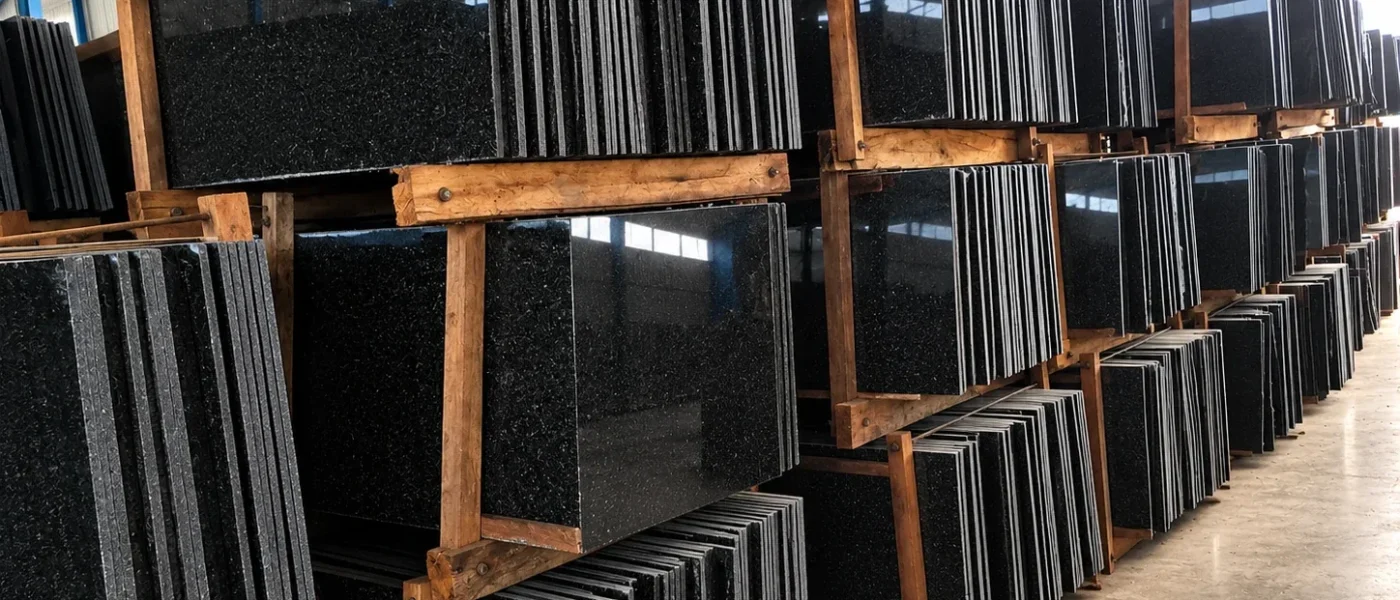
When considering Cambodian Black granite advantages, compare the actual surface, intended application, and installation requirements instead of relying on the trade name alone. This guide focuses on checks that can be completed before material approval.
Natural stone varies from slab to slab and batch to batch. Water absorption, strength, thickness, and load capacity should only be quoted from documentation for the specified product, alongside the approved sample and project drawings.
1. Geological Origin and Mineralogical Identification
Quarried from extensive open-cast igneous deposits in Snoul District, Kratie Province (Cambodia) adjacent to Vietnam’s southern border, this stone classifies petrographically as a plutonic gabbro-basalt rock abundant in dark pyroxene and calcic plagioclase feldspar. You can also refer to our guide on “Cambodian Black and Suoi Lau White Granite in Common Applications” to compare technical suitability for your installation.
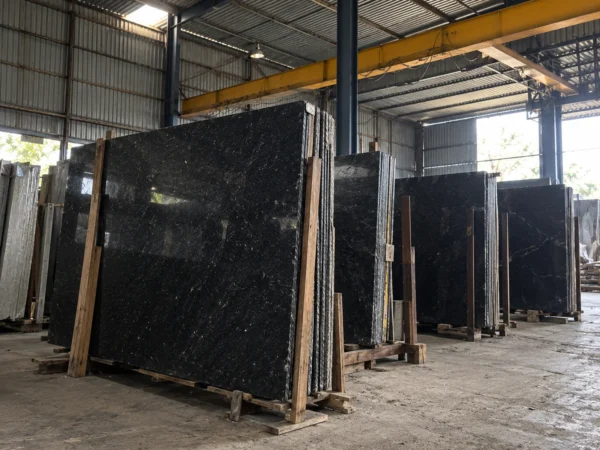
It exhibits a deep, uniform jet-black background displaying subtle emerald-black undertones in natural daylight. Its micro-crystalline grain structure remains remarkably consistent, avoiding the conspicuous white blotches characteristic of regional Phu Yen granite.
2. Comparing Cambodian Black with Indian Black and Phu Yen Black
A comparative analysis illustrates why Cambodian Black is preferred by project developers: You can also refer to our guide on “Cambodian Black or Black Galaxy: How to Compare Alternatives” to compare technical suitability for your installation.

- Phu Yen Black: Features noticeable white feldspar speckling and lower polish reflectivity, yielding a mottled dark grey appearance rather than true obsidian black.
3. Notable Physical Properties: Water Resistance and High Compressive Strength
Thanks to dense crystalline packing, Cambodian Black exhibits outstanding engineering metrics:
- Ultra-Low Absorption Rate (< 0.15%): Shields installations against efflorescence, moisture discoloration, and capillary substrate migration.
4. Practical Applications in Construction
Given its deep tone and robust weather resistance, Cambodian Black Granite is widely specified for: You can also consult our technical reference on “Granite Slabs: Patterns and Architectural Applications” for comprehensive engineering specifications.
- Entrance Portico Steps and Thresholds: Subjected to rainwater, direct UV exposure, and abrasive footwear grit.
- Stair Treads and Elevator Portal Jambs: Creating bold architectural contrast against white or cream interior wall cladding.
- Plinth Wall Cladding and Gate Pillars: Anchoring building bases with visual weight while disguising roadside rain splash.
5. Technical Acceptance Standards for Cambodian Black Stone Installation
Approving the Material for Its Application
A trade name identifies a material family but does not replace slab review. Inspect the actual stone under lighting close to the intended space, compare lighter and darker areas, and agree on an acceptable range of colour and vein variation.
Polished, honed, flamed, and textured finishes differ in appearance and maintenance. Select the finish for the indoor or outdoor location, expected moisture, foot traffic, and cleaning requirements rather than assuming one finish suits every use.
Before cutting, verify field dimensions, vein direction, joint locations, openings, and the supporting structure. These details affect layout and breakage risk; a trade name or promotional image cannot replace coordinated drawings.
At delivery, check batch references, quantity, ordered thickness, edges, and surface condition. Use technical values only from the test report for the specified product or batch.
For routine care, use a soft cloth, clean water, and a pH-neutral cleaner. Blot oils, coffee, and coloured spills early, and use trivets in heated areas. Sealing intervals should follow the stone, exposure, and product guidance rather than a universal schedule.
Price: Contact us